Optimisation loops, not shapes
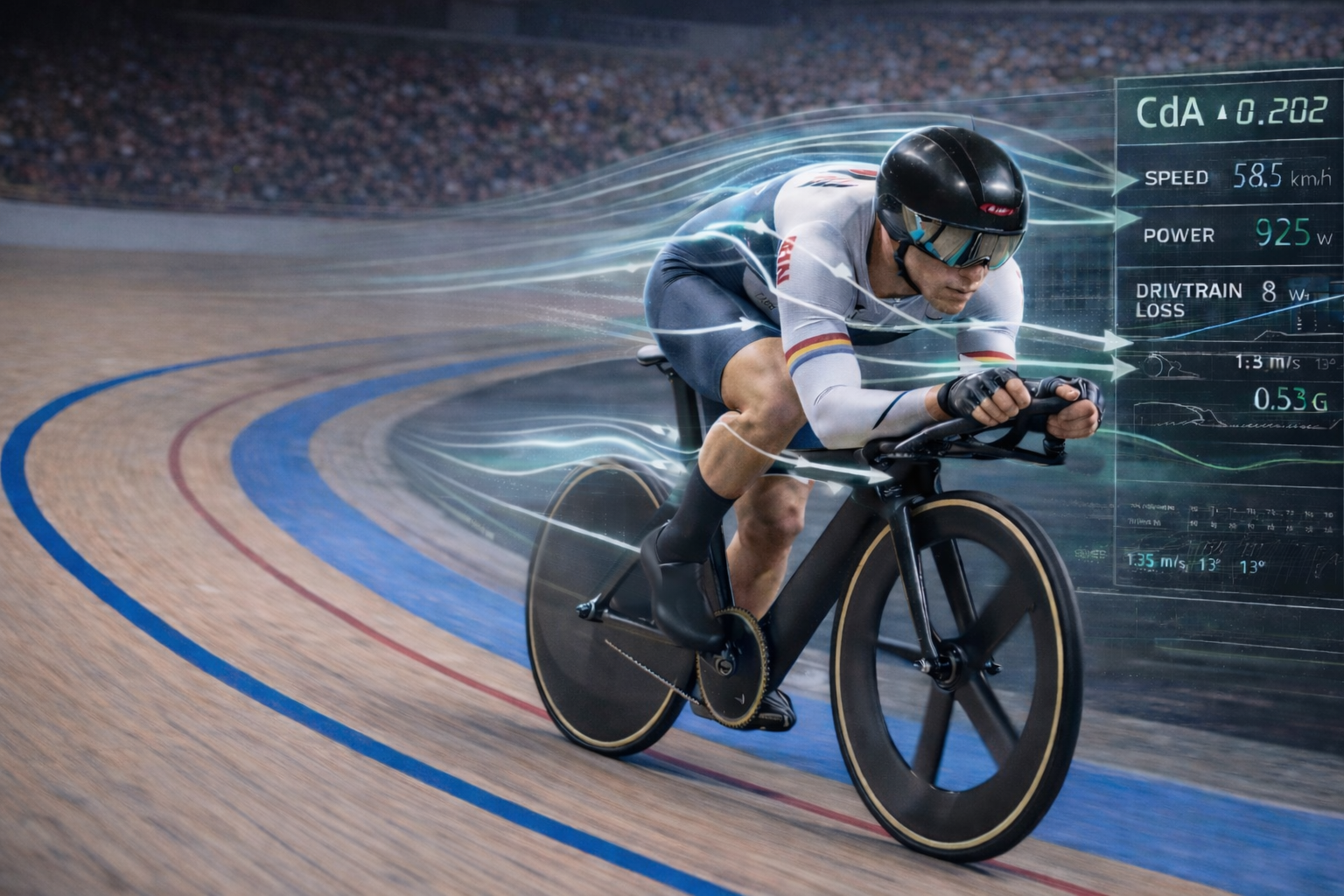
Elite equipment development is not really a sequence of shapes. It is a sequence of optimisation loops.
A constraint appears. The performance target is redefined. The variables that matter most shift. And the entire development process reorganises around those variables until a new equilibrium is reached.
That is what the 2027 dimensional regulation does to track cycling.
It does not end the line of thinking that produced the Paris bike.
It simply moves the problem somewhere else.
The problem has moved
The aerodynamic philosophy that underpinned the Paris equipment was straightforward once it was understood.
Instead of optimising the bicycle in isolation, the system was designed around the aerodynamics of the rider. The bicycle became a device for altering the air before it reached the body and managing the wake that followed it.
Lateral stance — particularly in the fork and rear triangle — was one of the most visible mechanisms used to achieve that.
Under the new regulation that mechanism is constrained.
The fork and seat stays can no longer occupy the same lateral space relative to the rider’s legs. The dimensional freedom that allowed direct control of the flow in those regions is reduced.
Where the work migrates
- From dimensional alignment
- To pressure distribution
- To wake behaviour
- To sensitivity management
But the underlying objective remains exactly the same. The aerodynamic cost of the rider still dominates the system. So the development effort does not stop. It migrates.
Where designers previously relied on dimensional alignment, the focus now shifts toward pressure distribution, wake behaviour and sensitivity management. Instead of using lateral stance to control the airflow directly, the system must shape the pressure field ahead of the rider and the wake behind them in more subtle ways.
The visible difference between generations of equipment may therefore be smaller than many observers expect.
The deeper change occurs in the optimisation process that produces those shapes.
From lowest number to fastest ride
Across all three event groups examined in this series — pursuit, sprint and bunch racing — the same conceptual shift appears.
The target is no longer the single lowest aerodynamic number measured in a perfectly controlled tunnel position.
Instead the target becomes the fastest ride that can be reproduced under the conditions that actually occur in racing.
In the pursuit that means developing a system that preserves aerodynamic efficiency as the rider fatigues and the position inevitably drifts.
In the sprint it means producing the lowest drag at peak speed while the rider is applying maximum torque and the bicycle is moving beneath them.
In the bunch events it means minimising the total energy cost of repeated accelerations and positional changes inside a turbulent flow environment.
Each discipline expresses the aerodynamic problem differently, but the underlying principle is the same.
The decisive variable is no longer absolute drag.
It is behaviour under load.
The rider becomes the primary design constraint
One of the quiet realities of modern equipment development is that, as regulations tighten, equipment itself tends to converge.
When dimensional freedoms are reduced, there are simply fewer ways to build radically different objects.
Human variation, however, does not converge.
Even within a single national team the riders can differ substantially in hip structure, femur length, spinal mobility, force-production patterns and fatigue resistance. These differences alter posture, power delivery and the way the body moves under load.
The platform that succeeds in Los Angeles will therefore not be the one that is perfect for a single rider in a single idealised posture.
It will be the one whose aerodynamic behaviour changes least across different riders, different power outputs and different race states.
That challenge cannot be solved purely through frame geometry.
It requires a system approach — one that considers the rider, the air and the mechanical structure as a single coupled entity.
One platform, three performance expressions
Under the new constraints, the most efficient development model is unlikely to involve three completely separate bicycles for pursuit, sprint and bunch racing.
Instead the logical solution is a single aerodynamic architecture capable of expressing three different behaviours.
In steady-state clean air it must reward pacing stability and allow the rider to maintain an efficient posture for extended periods.
At peak speed it must remain aerodynamically correct while the rider is producing maximum torque and the flow angle varies with yaw.
In disturbed flow it must allow the rider to remain low, accelerate repeatedly and control the bike without paying a large energy penalty.
The physical structure of the platform may remain largely constant.
What changes is how the airflow interacts with that structure through the rider.
This is the deeper implication of the new regulation: not a single new shape, but a system capable of solving several different aerodynamic problems simultaneously.
Measurement defines direction, racing defines truth
The tools used to develop these systems are already familiar.
Wind tunnels allow engineers to map aerodynamic sensitivity and understand how drag changes as positions shift.
Computational fluid dynamics reveals where energy is lost in the pressure field and how the wake evolves behind the rider.
Track testing determines whether the rider can reproduce the aerodynamic state under race power.
And in the bunch events, the final validation often comes not from a speed trace but from race data: the energy required for each acceleration, the time a rider can remain in position, the repeatability of sprint output after repeated efforts.
Each tool answers a different question.
The tunnel defines direction.
The track determines whether the system works.
The race ultimately reveals whether it wins.
The new optimisation hierarchy
Within that process the order of priorities becomes increasingly clear.
First, the system must allow the rider to produce the required power in the posture demanded by the event.
Second, the aerodynamic behaviour of the system must remain stable as the rider moves under that load.
Only after those two conditions are satisfied does the reduction of absolute drag become the dominant objective.
Order of operations
- Allow maximum sustainable power in the required posture.
- Make aerodynamic behaviour insensitive to movement under load.
- Reduce absolute drag within that stable system.
For decades aerodynamic development in cycling often followed the reverse order: first find the lowest drag shape, then attempt to adapt the rider to it.
Under modern constraints that logic rarely survives contact with real racing.
The fastest system is not the one with the lowest theoretical drag.
It is the one whose aerodynamic behaviour remains predictable while the rider is actually riding the bike.
Development speed becomes the real advantage
At the highest level of the sport, most programmes have access to similar tools. Wind tunnels, CFD resources and high-precision track testing are no longer rare.
What differentiates programmes is not the availability of these tools but the speed with which the optimisation loop runs.
test → interpret → adapt → validate → repeat
Over the course of an Olympic cycle, the number of meaningful iterations a programme can complete often matters more than any single breakthrough.
A platform that allows rapid iteration across multiple riders and multiple race scenarios is therefore far more valuable than one that produces a marginal aerodynamic gain in a single configuration.
Because over four years, development velocity becomes performance.
Convergence and separation
By the time the Los Angeles Games arrive, track bicycles will likely appear more similar in plan view than they did in Paris.
The regulations will ensure that.
But the real differences between programmes will not be visible in silhouette.
They will appear in subtler characteristics: the stability of the pressure field ahead of the rider, the size and energy of the combined wake behind them, the sensitivity of the system to posture drift and the degree to which aerodynamic optimisation is integrated with pacing and race models.
These are not qualities that show clearly in photographs.
But they are the qualities that decide medals.
The final performance question
Perhaps the most useful way to think about the next generation of equipment is not as an object at all.
Instead it can be understood as an interface.
An interface between the rider and the air, between the power the athlete can produce repeatedly and the race environment in which that power must be deployed.
The visible shape of the bicycle is simply the physical expression of that interface.
What matters more is how effectively the system allows the rider to convert physiological capacity into race performance.
Seen in that context, the philosophy that produced the Paris bike does not disappear when the wide stance disappears.
If anything, it becomes more complete.
Paris demonstrated that the bicycle could be designed as an aerodynamic device for the rider.
Los Angeles will demonstrate that the entire development process must be organised around how that rider produces power, moves under load and races within different aerodynamic environments.
The object itself may become less visually extreme.
The system behind it will become more refined.
When the start gate opens in Los Angeles, the decisive equipment question will not be which bike produces the lowest drag number in a wind tunnel. The real question will be much simpler.
That question defines the end point of the optimisation loop, and it is why the most important developments of the next Olympic cycle may not be visible in photographs of the equipment itself.
They will be visible in lap times, terminal speeds and the number of race-winning actions a rider can perform before they run out of energy.
The regulation has placed the system inside a box. The competitive advantage will come from how completely that system is understood.