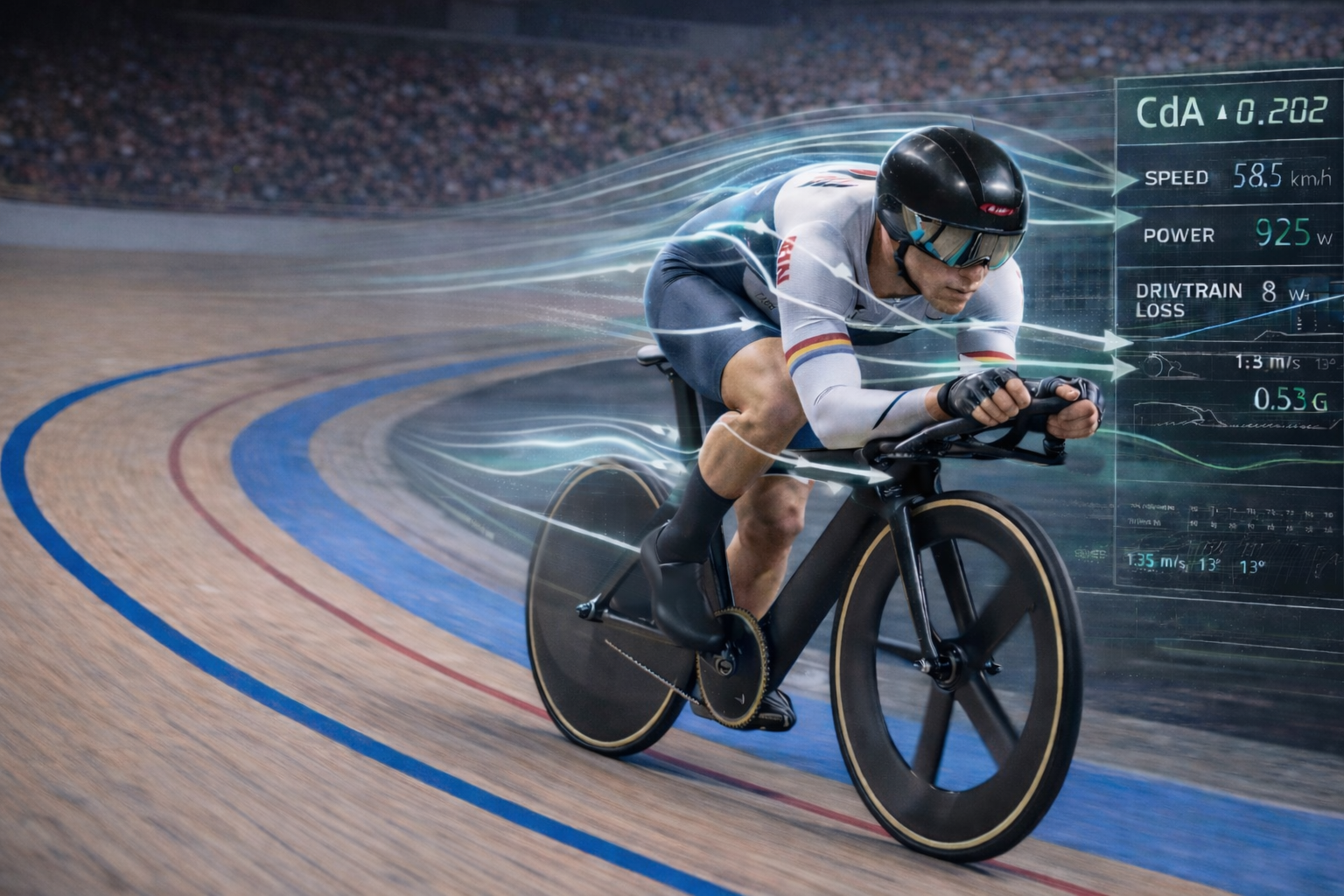
Once the flow reaching the rider is dominated by the wake of other riders, the objective of aerodynamic optimisation changes completely. The goal is no longer to minimise drag in isolation. Instead it becomes something much more complicated: maintaining aerodynamic effectiveness while the flow itself is unstable, the rider’s position is constantly changing and the effort pattern of the race is defined by repeated accelerations.
In that environment, performance is no longer defined by the lowest CdA number.
It is defined by how often a rider can access a low-cost aerodynamic state — and how little they pay when they leave it.
The race model comes first
In the bunch events the race model dictates the equipment problem far more directly than it does in either pursuit or sprinting.
Points races, elimination races, scratch races and the madison are all built around short, violent efforts that repeat again and again throughout the event. Riders move constantly between sheltered and exposed positions, and the decisive actions of the race almost always occur after a rapid acceleration out of the wheels.
A typical sequence might look like this:
- a rider sits low in the slipstream of the group
- moves up half a lane to close a gap
- accelerates briefly to hold position
- settles back into the line
- then launches again several laps later
That pattern repeats dozens of times over the course of a race.
The aerodynamic system therefore has to function across all of those states.
The fastest configuration in clean air is of limited value if the rider cannot repeatedly enter and exit that configuration while racing. In bunch racing the optimisation target shifts away from the lowest drag at a single speed and toward the lowest total energy cost across the entire race.
That energy accounting ultimately decides who still has the capacity to sprint when the decisive moment arrives.
Dirty air is not lower drag — it is unstable drag
It is easy to assume that riding in the wheels simply reduces aerodynamic load.
In reality the aerodynamic environment inside a bunch is far more complicated than that.
Yes, the average drag on a rider is lower when they are sheltered. But the airflow they experience is also far more chaotic. The wake of another rider produces highly turbulent inflow, rapidly changing yaw angles and pressure fields that fluctuate continuously.
This means the aerodynamic problem is not simply one of reduced drag.
It is one of instability.
The key question becomes whether the rider can continue to produce power and control the bicycle while the flow around them is constantly changing. A platform that performs beautifully in clean air but reacts badly to turbulent inflow will cost the rider energy every time they move up the track or accelerate out of the group.
Those small energy costs accumulate lap after lap.
And over the course of a forty or sixty kilometre race they can determine the outcome just as clearly as any sprint.
Multi-position aerodynamics
One of the most important differences between bunch racing and the other track disciplines is the number of positions a rider must adopt.
A pursuit position is fixed and singular. The rider aims to hold it for the entire race.
A bunch-race position is anything but fixed.
Multi-state objective
- Low drag seated in wheels
- Low penalty during seated acceleration
- Controlled drag when rising
- Stable aerodynamics during sprint
A rider must be aerodynamically effective while sitting low in the wheels, while accelerating in the saddle, while raising slightly to see and react to the race around them, and while sprinting out of the saddle at the end of a lap.
These are not minor variations of a single posture. They are fundamentally different aerodynamic states.
The fastest system is therefore not the one that produces the lowest drag in any one of them. Instead it is the one that produces consistently low drag across all of them.
In other words, the system must be forgiving.
The aerodynamic penalty for moving between these positions must remain small enough that the rider can race naturally without paying an excessive energy cost.
Time in position is performance
Because bunch racing is so dynamic, the key aerodynamic variable is not peak efficiency.
It is time.
More specifically, it is the amount of time a rider can remain in an efficient position while still being able to see the race, control the bike and respond to attacks.
A configuration that is theoretically faster in the tunnel but forces the rider to sit up frequently — to handle the bike, to change line or simply to breathe — will cost energy on every lap.
By contrast, a system with slightly higher absolute drag but which allows the rider to remain low and stable for longer periods will almost always be faster over the duration of the race.
This is the bunch-racing equivalent of robustness in the pursuit. The system that loses the least efficiency as the rider moves and reacts is the system that conserves the most energy.
Handling as an aerodynamic variable
In turbulent flow, bicycle handling becomes part of the aerodynamic system.
If the rider must widen their elbows, raise their torso or shift their weight to stabilise the bike, their frontal area increases and the aerodynamic cost rises.
Principle: The fastest aerodynamic platform in bunch racing is the one that requires the fewest posture corrections to control.
Handling stability therefore has a direct aerodynamic consequence.
The fastest aerodynamic platform in bunch racing is not the one with the most aggressive shape. It is the one that allows the rider to remain relaxed and stable in the wheels without making constant posture corrections.
Every unnecessary correction costs energy.
And energy is the true currency of bunch racing.
Acceleration cost is dominant
Another defining characteristic of bunch events is the frequency of accelerations.
In a pursuit the rider accelerates once and then settles into a steady pace.
In bunch racing, acceleration happens repeatedly — sometimes dozens of times over the course of a race.
Each acceleration typically begins from a partially sheltered position in the bunch and moves into exposed air as the rider launches an attack or closes a gap.
The critical question is therefore not simply how much drag the system produces at a constant speed.
It is how much energy is required to make that transition from sheltered to exposed.
A platform that is slightly higher drag at steady speed but significantly lower drag during the first seconds of acceleration can allow a rider to make more moves and recover more quickly between them.
That is a direct performance advantage.
The front of the system in turbulent flow
Under the new dimensional constraints the leading edge of the bike–rider system again becomes extremely important.
But its function in bunch racing is slightly different from the pursuit or the sprint.
In turbulent inflow the front of the system must do more than reduce drag. It must produce a pressure field that behaves predictably even when the incoming flow is chaotic. It must prevent sudden spikes in drag that occur when turbulent air interacts with the rider’s body. And it must allow the rider to steer and control the bike without destabilising the aerodynamic state.
In this context aerodynamic stability is not about maximising straight-line speed.
It is about allowing the rider to hold position in the bunch without wasting energy on constant adjustments.
Cross-rider performance
National programmes rarely develop equipment for a single athlete in bunch events.
Instead the same platform must work effectively for several riders whose body shapes, riding styles and sprint characteristics may differ significantly.
Differences in shoulder width, arm length or sprint technique can all alter the aerodynamic behaviour of the system.
This reinforces the importance of robustness.
The fastest platform is not the one that is perfect for one rider in one posture. It is the one whose aerodynamic behaviour remains stable across different morphologies and across the wide range of positions required during a race.
Measurement hierarchy
Because the aerodynamic environment of bunch racing is so complex, wind tunnel numbers alone are rarely decisive.
Tunnel testing and CFD analysis can still reveal valuable information about positional drag, sensitivity to yaw and the behaviour of different body angles.
But only the track — and ultimately race data — reveals the true performance of the system.
Track testing shows the energy cost of repeated accelerations, the time required to recover between efforts and the ability of a rider to remain in position without excessive corrections.
In bunch racing the performance metric is not speed alone. It is the ability to perform race actions repeatedly and efficiently.
The energy model
Over the course of a points race or madison the decisive variable is rarely maximum velocity.
Instead it is the total amount of energy required to achieve the race objectives — whether that means scoring intermediate points, surviving eliminations or launching the decisive sprint.
Aerodynamics influences this total energy cost by reducing the cost of moving through the bunch, closing gaps and accelerating repeatedly.
The Los Angeles bunch-racing problem
Within the new regulations the winning bunch-race platform will not resemble a pursuit bike scaled for different riders.
It will be the one that:
- Produces low drag across realistic postures
- Remains stable in turbulent inflow
- Allows the rider to stay low while maintaining control
- Minimises energy cost of repeated accelerations
- Behaves consistently across different riders
It must also perform consistently across different riders within the same programme.
In other words, the system must turn aerodynamics into a tool for race positioning and race frequency rather than pure top speed.
Why this passes the programme test
This framing starts from the race model, treats energy rather than CdA as the outcome variable, integrates handling as an aerodynamic factor, centres repeat accelerations, and uses race performance as validation.
That is how bunch-event equipment is actually evaluated.
Across the series the aerodynamic objective has changed three times.
In the pursuit the goal is to maintain efficiency as fatigue alters the rider’s posture.
In the sprint the goal is to minimise drag at peak speed while the rider is producing maximum torque.
In the bunch events the goal is to minimise the total energy cost of racing in unstable flow.
The platform itself does not change.
What changes is how the air interacts with that platform through the rider.
That is the deeper implication of the post-2027 constraint.
Not a single new shape. A single aerodynamic system capable of solving three different performance problems.