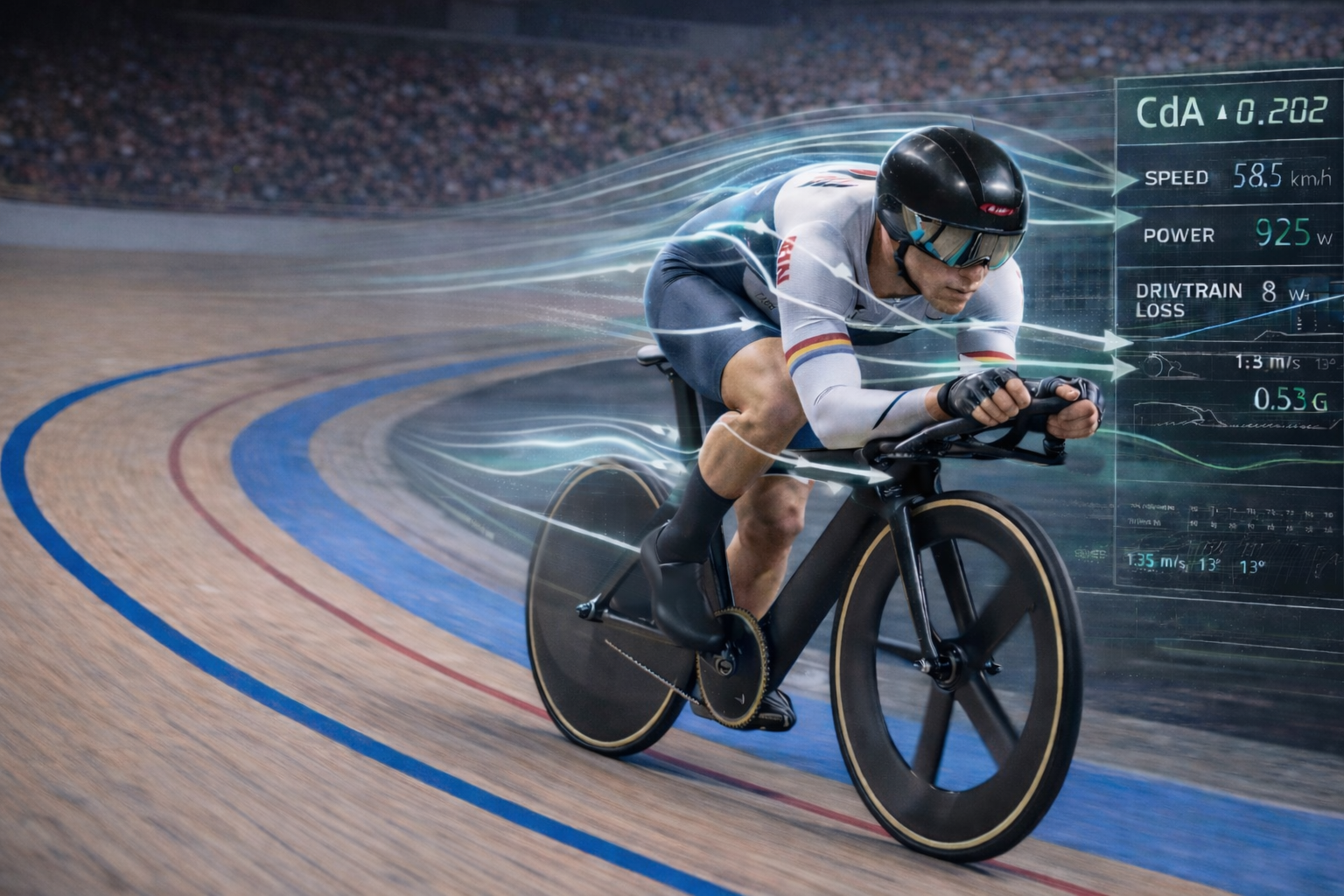
Paris: The inversion
In the Track Centre in Paris, the bicycle did not conform to the established aerodynamic aesthetic of the previous decade. It did not attempt to vanish beneath the rider. It did not present the narrowest possible frontal signature. The fork legs were visible in clean air. The rear structure did not apologise for its stance.
In still photography, it appeared aerodynamically compromised.
In timing data, it was not.
For two decades, pursuit-bike philosophy centred on reducing frame drag and placing the rider behind it. Paris inverted that hierarchy. The bicycle became a pressure-field modifier for the rider's body.
The key distinction is between optimising a bicycle and optimising a coupled rider-bicycle system. Paris was the clearest expression yet of system-first thinking in modern track cycling.
The mechanism: Trading drag domains
The wide front stance was not cosmetic. It was a deliberate manipulation of stagnation behaviour ahead of the rider's lower legs. In conventional configurations, the shins sit in clean, high dynamic-pressure flow, generating a costly stagnation pressure rise and an energetic local wake. By placing structure laterally in alignment with the leg envelope, the flow encountered the fork first.
The fork created its own pressure distribution and shed its own wake. The rider's shins then operated inside air that had already been conditioned.
Drag Domain Exchange
- Accept a small increase in frame drag.
- Reduce rider drag by more than that increase.
- Net system CdA decreases.
- Wake energy is redistributed and reduced, not simply hidden.
At the rear, the same principle applied inversely. Structure positioned within already disturbed rider wake carries lower incremental penalty than structure placed in clean flow. In system terms, you spend drag where it is cheapest and save it where it matters most.
A note on yaw and stability
Velodrome aerodynamics is often described as "zero yaw", but real riding is not a static, perfectly aligned laboratory case. Track curvature, micro-steering inputs, rider sway, and local incidence changes around moving limbs all create small but meaningful variations in effective flow angle. The practical objective is not peak performance at one condition, but stable behaviour across the narrow band of conditions a rider actually produces at race power.
Tokyo to Paris refinement
The concept did not appear fully formed in Paris. It evolved. Surface continuity improved separation control. Cockpit transitions reduced local turbulence. Geometry enabled lower sustainable torso angles, modifying upstream flow conditions.
The philosophy remained stable: the rider dominates drag; the bicycle shapes the air around them.
Why the visuals mislead
Track bikes are often judged like standalone aero objects. But the rider changes everything. A shape that looks slower as a bicycle can be faster as a system if it reshapes the pressure field that reaches the legs, hips and shoulders.
The 2027 constraint
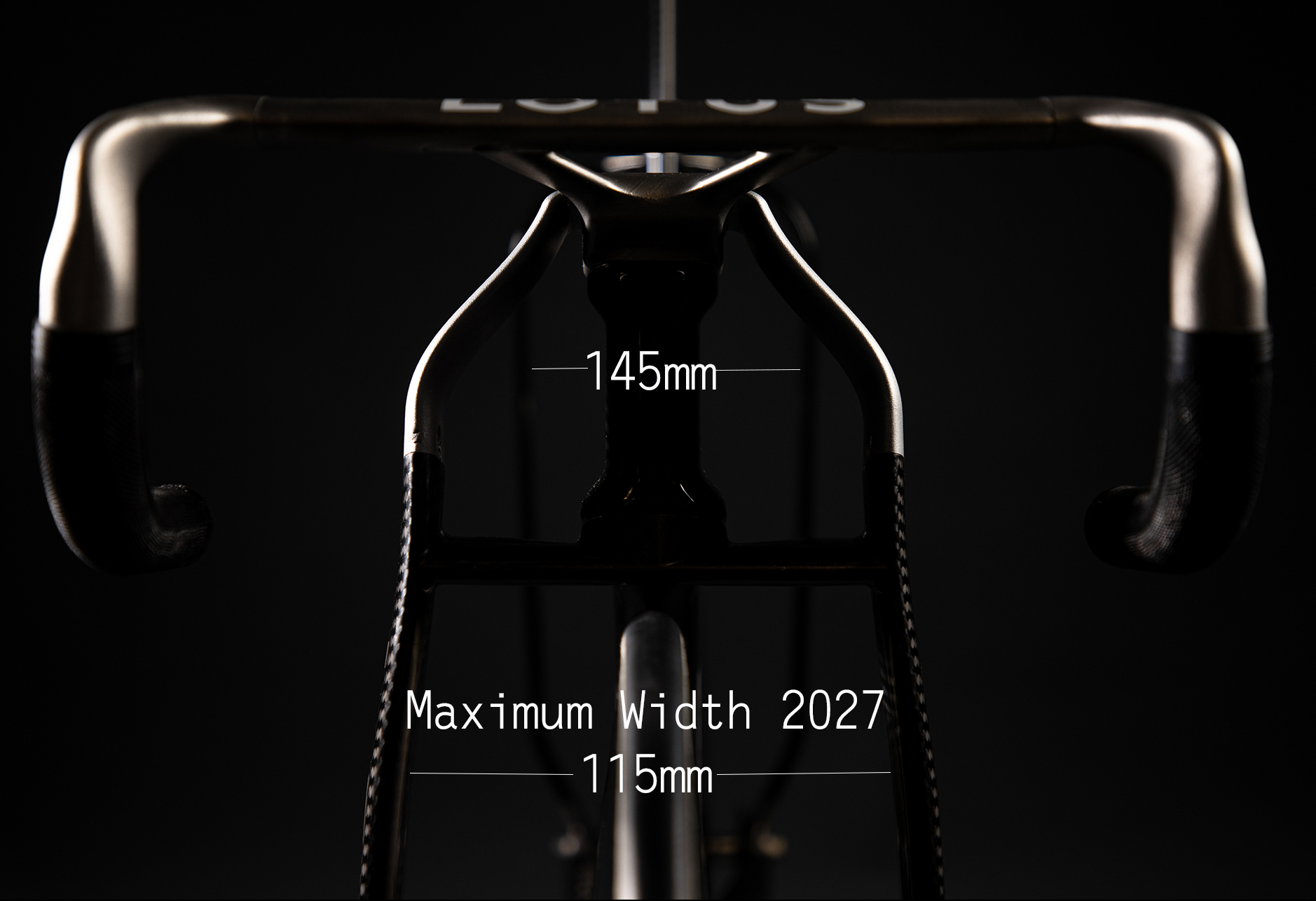
2027 Regulation Changes
- Maximum Fork Width: A maximum internal fork width will be enforced: 115 mm at the front.
- Maximum Rear Stay Width: A maximum internal width for the rear triangle (seat stays/chain stays) will be enforced: 145 mm.
- Scope: This rule applies to the entire length of the front fork and rear triangle, directly impacting, and likely banning, current ultra-wide designs like the Great Britain's Track Bike Factor Hanzo used by Australia, Look P24 used by France and Japan's Track Bike
The UCI signalled a full-length width restriction for track from 2027, but only made that position fully explicit in the written technical rule set from 7 September 2027, when the separate track end-point exemption was removed.
That does not simply make wide bikes illegal. It removes lateral stance as the primary flow-control lever that enabled Paris-style conditioning.
Regulatory Impact
- Loss of lateral stance as the primary flow-control tool.
- Reduced ability to align fork structure with the leg envelope.
- Rear wake placement constrained by geometry limits.
- System objective unchanged.
The tool disappears. The drag target does not.
From width to pressure
With lateral freedom reduced, optimisation migrates to distributed mechanisms. When you cannot use width to do the work, you use pressure, separation and wake structure.
- Leading-edge pressure gradient control (what air arrives at the rider, and with what energy).
- Separation delay and management at junctions (cockpit, head tube, shoulders).
- Forearm-to-torso flow coherence (preventing early breakdown into a larger wake).
- Wake structure management (smaller, more stable wakes beat larger, bursty wakes).
- Pressure recovery (reducing the energy deficit behind the rider).
The New Primary
In the narrow-rule era, where the parts sit matters less than what pressure field they create. The engineering question becomes: what pressure distribution arrives at the shins, knees and hips, and how stable is that distribution when the rider moves?
Sensitivity vs optimisation
Wind-tunnel minima often represent fragile configurations. Track racing does not occur in static posture. It occurs under fatigue, micro-movements, and small changes in joint angle that are inevitable across a four-kilometre effort.
Sensitivity variables
- Arm width variation (even 10-20 mm matters).
- Head height drift (cervical fatigue is aero fatigue).
- Postural change under load (hip angle, shoulder shrug, forearm pressure).
- Morphological differences between riders (same bike, different wakes).
A marginally higher ideal CdA paired with greater robustness across race conditions yields faster lap times than a fragile absolute minimum. Engineers do not chase the lowest number; they chase the lowest sensitivity.
Platform architecture
Once sensitivity becomes the objective function, architecture beats isolated shape optimisation. A narrow-rule platform must behave like a system device:
- Generate a coherent leading pressure field without relying on lateral stance.
- Maintain cockpit-to-torso flow continuity to delay wake growth.
- Support low-sensitivity rider positioning (race-holdable, not tunnel-perfect).
- Place rear structure inside stable wake boundaries where penalty is lowest.
- Remain aerodynamically predictable across yaw, not just at zero yaw.
System architecture summary
- Front: Pressure shaping.
- Mid: Flow coherence and separation control.
- Rear: Wake energy minimisation and recovery.
- Whole system: Behavioural stability under realistic movement.
Measurement framework
Evaluation extends beyond single CdA figures. The objective is not a shape. It is predictable behaviour.
- Pressure mapping ahead of legs (what arrives at the shins, not just total drag).
- Wake volume and turbulence energy (how much energy you leave behind).
- Yaw sensitivity sweeps (stability beats peak performance).
- Fatigue-repeatability track testing (do laps stay fast when posture drifts).
- Cross-rider robustness (one platform must work across a squad).
The output is a platform with predictable aerodynamic behaviour across real racing conditions, not an optimiser's single best shape in a single position.
Toward Los Angeles
The winning solution in Los Angeles will not be the narrowest bicycle. It will be the system that most effectively manages pressure distribution, wake energy and positional robustness within regulation.
Paris demonstrated the power of system thinking. LA will test the evolution of that thinking when the original lateral mechanism is no longer available to do the work.
Next in the series
Part 2 examines how the same platform behaves in the clean-air, steady-state environment of the team and individual pursuit - where absolute drag still matters, but robustness to posture drift becomes the decisive performance factor.