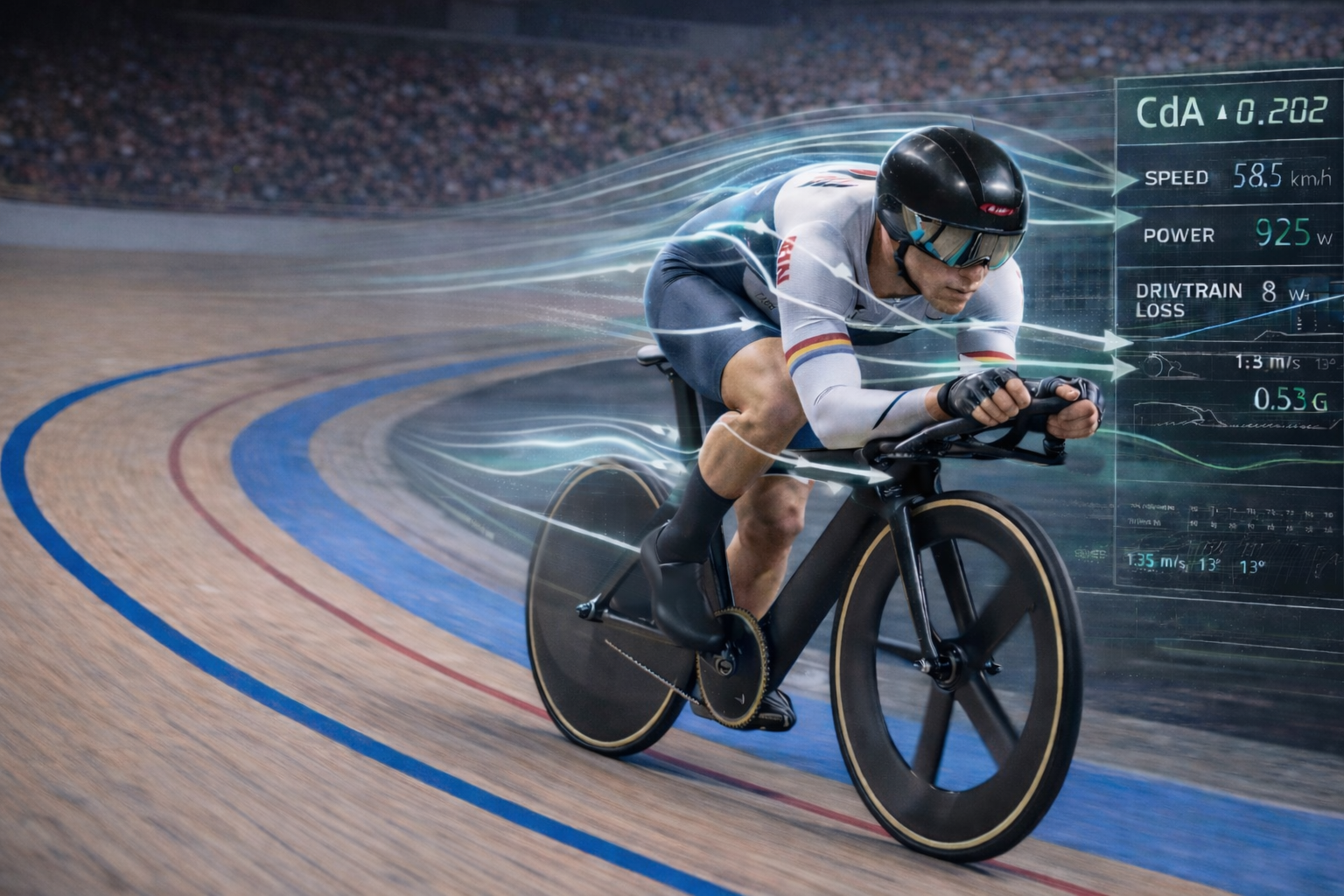
Behaviour one: The pursuit and the clean-air problem
In the team pursuit and the individual pursuit there is nowhere to hide.
For four kilometres the rider sits in clean air at a near-constant power output. The flow field does not change, the pacing model is pre-committed, and the stopwatch is sensitive enough that the smallest shifts in system behaviour appear as real time on the board.
That is why pursuit has always been the event in which aerodynamic development runs closest to first principles.
It is also why the shift from a stance-driven system to a pressure- and wake-driven system matters most here.
Because in the pursuit, performance is not decided by the lowest drag in the first kilometre.
The objective: lap time, not CdA
The aerodynamic target in a pursuit is often described as "minimum CdA".
In practice, the real target is the lowest aerodynamic cost of sustaining race power for the full distance. That is a pacing problem.
The real objective function
- Headline metric
- Lowest CdA in a held tunnel position
- Race metric
- Lowest time cost of sustaining race power across 4 km
- Failure mode
- Low CdA that forces a posture that degrades under load
- Winning condition
- Low sensitivity to fatigue drift with near-optimal CdA
A configuration that produces the lowest drag in a perfectly held position but forces the rider into a posture that degrades under load will lose time, even if its headline CdA is lower.
The fastest system is the one that allows the rider to produce the required power and maintain aerodynamic effectiveness as fatigue accumulates.
Clean air exposes sensitivity
In bunch racing, small aerodynamic instabilities can be hidden inside a constantly changing flow environment. In a pursuit they are exposed immediately.
- A one-centimetre rise in head height.
- A gradual widening of the elbows.
- A slight change in knee tracking as force production falls.
Each of these alters the pressure field.
So the key variable is no longer the absolute minimum drag in an idealised position. It is the rate at which drag increases as the position drifts.
Robustness as a metric
Robustness is measurable as a slope: d(CdA)/d(position drift). In a pursuit, that slope maps directly to lap time because posture drift is monotonic under fatigue.
Robustness becomes a measurable performance metric. And in a four-kilometre effort, that robustness directly alters the pacing strategy. A system that degrades more slowly allows a higher opening power without paying for it in the final kilometre.
The rider as a control system
In engineering terms, the rider is not a fixed shape. They are a control system operating under load.
Joint angles change. Force production changes. Postural stability changes.
The equipment has to produce stable aerodynamic behaviour for the outputs that system can repeat.
The front of the system: pressure-field generation
With lateral fork stance constrained, the first decisive control point is the leading edge of the entire system.
The function of the fork and head structure is no longer to sit in line with the legs. It is to generate a stable pressure distribution that conditions the air for the rider's body.
A deep, long-chord front structure can create a region of reduced velocity and altered pressure immediately downstream. If that region is correctly located, the rider's shins and knees operate inside a flow that is already partially modified.
Mechanism shift: Paris used width as the main flow-control lever. Post-2027 pursuit work shifts toward pressure distribution, separation control and wake energy management.
The mechanism is different from the Paris solution. The aerodynamic objective is the same.
The cockpit as a leading edge
In the pursuit position, the forearms are among the most influential aerodynamic surfaces in the entire system. They are also one of the first surfaces the air encounters.
That makes the cockpit a primary flow-control device.
Its geometry determines how stable the pressure field is ahead of the torso, how sensitive the system is to small changes in arm width, and how much drag increases when the rider fatigues.
What to sweep
- Arm-width sweeps map aerodynamic sensitivity (not just a single minimum).
- Head-height drift tests quantify late-race penalty.
- Elbow angle and wrist height isolate pressure-field stability.
The lowest-drag arm position in a static tunnel test is not automatically the fastest in a race.
The fastest is the one that produces near-optimal drag across the range of positions the rider can actually hold.
Leg interaction as a kinematic problem
The aerodynamic cost of the legs does not disappear with the loss of wide fork stance. What changes is how that interaction is managed.
The leg is not a static body. It is a periodic disturbance whose phase, amplitude and tracking change under fatigue and with cadence.
The relevant question is no longer: how far apart can the fork legs sit?
That is a pressure-field and timing problem, not a dimensional one.
Pressure recovery and the wake
In a pursuit position, the rear of the system operates almost entirely inside the rider's wake. This remains true under the new regulations.
What becomes decisive is not the lateral spacing of the rear structure, but how effectively the flow behind the rider is slowed, stabilised and returned to the free stream.
Wake energy
A platform that reduces the energy of the combined wake produces a direct lap-time gain, because the rider is effectively riding inside a lower-drag environment of their own making.
The rear triangle does not need to be aerodynamically minimal in isolation. It needs to exist in air that has already lost most of its energy.
One platform, four riders
The team pursuit introduces a constraint that dominates real equipment decisions: four different bodies must produce near-identical lap times.
Differences in femur length, hip width, shoulder width and ankle path all alter the flow field.
The fastest platform is therefore not the one that produces the lowest drag for the most compact rider. It is the one whose aerodynamic behaviour changes least across all four.
The optimisation loop in practice
Under a stance-driven model, development work involved lateral positioning and alignment. Under a pressure-driven model, the loop changes.
Tunnel loop
- Arm-width sweeps map aerodynamic sensitivity.
- Head-height drift tests quantify fatigue effects.
- Leg-tracking variations show phase interaction with the fork wake.
The tunnel defines direction. On the track, the validation is decisive. In the pursuit, the track defines truth.
Track loop
- Lap-time stability in the final kilometre.
- Repeatability under race power.
- Cross-rider consistency.
Because that is what wins medals.
The lap-time model
Absolute drag does not stop mattering. If two systems are equally robust, the one with the lower CdA will be faster.
But when robustness differs, the more stable system will almost always produce the better ride. Because pursuit performance is determined by the rate at which efficiency is lost, not by the peak efficiency in the opening laps.
From trackside, the difference between two pursuit systems can look negligible. In the pacing model it is decisive.
A platform that is fractionally higher in perfect-position CdA but significantly less sensitive to posture drift allows a higher sustainable power, a more aggressive opening strategy, and a smaller performance drop in the final kilometre.
The Los Angeles pursuit problem
Within the new regulations, the winning pursuit platform will not be the one that most closely resembles the Paris bike at reduced width.
It will be the one that generates the most stable pressure field ahead of the rider, produces the smallest and least energetic combined wake, allows the lowest sustainable torso angle at race power, maintains aerodynamic effectiveness as the rider fatigues, and behaves consistently across four different morphologies.
The pursuit platform that wins in 2027+ is not an imitation of the Paris mechanism. It is a pressure- and wake-driven system engineered for low sensitivity to race-real movement.
In other words, the one that turns aerodynamic optimisation into a problem of lap-time behaviour rather than shape.
Next in the series
Part 3 moves to the sprint, where airspeed increases, yaw becomes a primary variable, and the optimisation target shifts from steady-state efficiency to peak-speed drag, structural load paths and aerodynamic stability through acceleration.