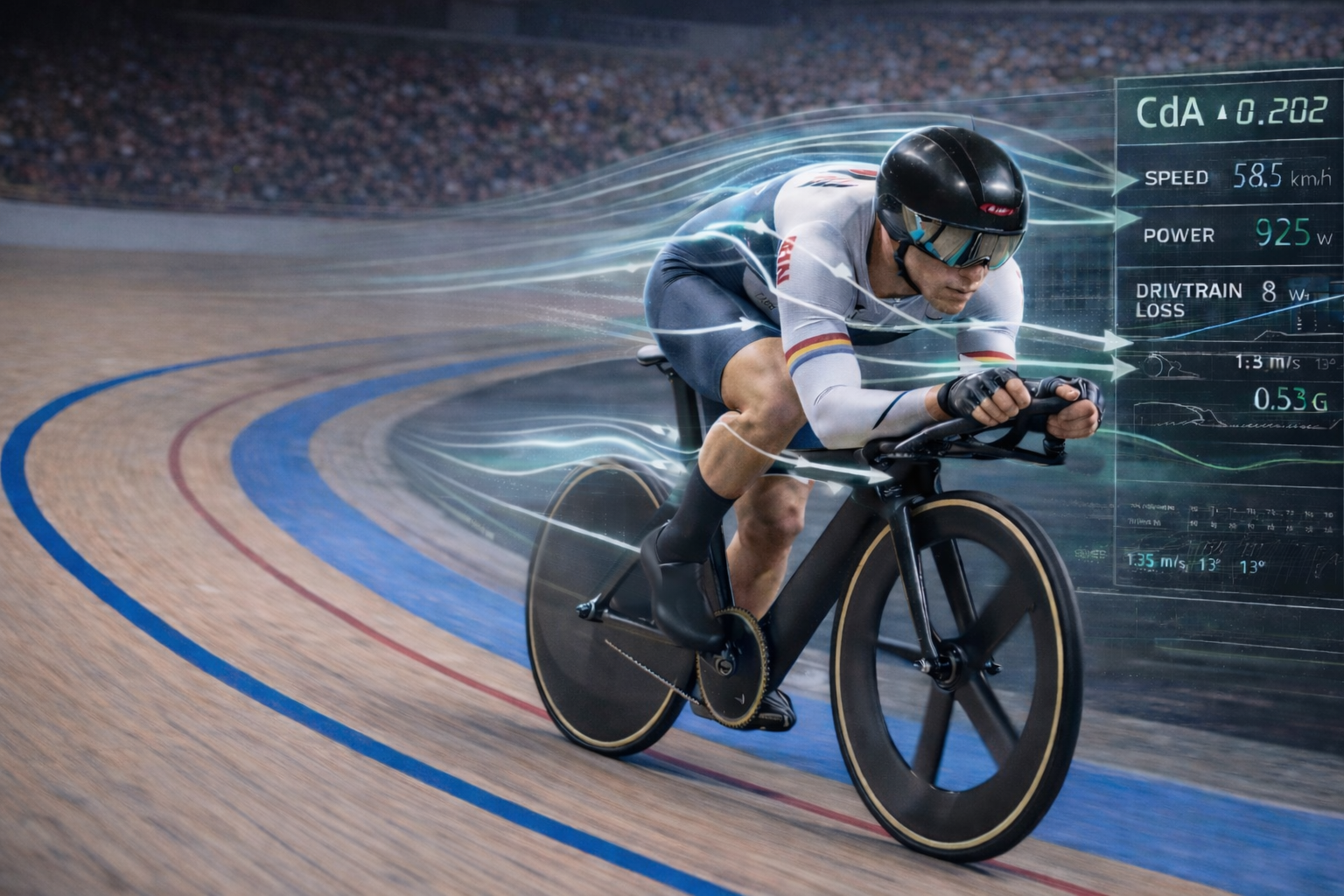
Aerodynamics still matters enormously. But the optimisation target changes. The question is no longer how efficient the system is when everything is perfectly controlled. The question becomes how much aerodynamic efficiency survives acceleration, lateral load and rapid changes in posture.
The fastest sprint system is therefore not simply the one with the lowest drag. It is the one that produces low drag at maximum speed and continues to do so while the rider is producing force.
The speed changes the hierarchy
The physics is simple but brutal.
Drag increases with the square of velocity. At sprint speeds even very small differences in CdA translate into meaningful differences in the power required to accelerate and maintain maximum speed.
But sprint racing introduces a complication that does not exist in the pursuit. The rider is not trying to hold a single aerodynamic posture for four minutes. Instead they are accelerating violently out of the saddle, rocking the bike from side to side, and then attempting to re-settle into a seated position at extremely high speed.
Why speed magnifies drag
At 70 km/h, a 0.005 m² change in CdA produces a disproportionately larger power penalty than at 55 km/h. Sprint speeds amplify small aerodynamic differences.
The aerodynamic configuration therefore has to function across several different states of movement.
A tunnel position that produces the lowest drag in a perfectly static posture may not be the fastest configuration on the track. If the rider cannot stabilise themselves in that position while producing peak torque, the frontal area increases, the airflow changes and the aerodynamic advantage disappears.
In sprinting, the fastest aerodynamic shape is the one that remains aerodynamically correct while the rider is producing force.
The fastest sprint system is not the one with the lowest drag in a static tunnel posture. It is the one with the lowest drag at maximum speed that remains aerodynamically stable while the rider is producing force.
Power, stiffness and aerodynamics are the same problem
Power, stiffness and aerodynamics are the same problem
This is why sprint optimisation cannot separate aerodynamics from structural behaviour.
At peak torque the rider is pulling against the extensions or base bar, driving through the pedals with large lateral forces and moving the entire bicycle underneath their body. Those forces travel through the structure of the frame, and if the structure deflects, the aerodynamic system changes with it.
If the front end of the bike moves under load, the aerodynamic leading edge shifts relative to the airflow. If the bottom bracket area deflects, the rider’s hip angle and torso height change. If the rider cannot stabilise their upper body while producing force, their frontal area increases.
Each of these effects alters the aerodynamic state of the system.
This is why sprint equipment development always treats stiffness and aerodynamics as a single coupled problem. The lowest-drag configuration is only useful if the structure allows the rider to apply maximum power within it.
A shape that is theoretically faster but mechanically unstable will almost always lose.
Yaw is not a disturbance — it is the normal condition
Another difference between pursuit and sprinting appears in the airflow itself.
In a pursuit, the rider spends most of the effort travelling in a straight line with minimal lateral movement. Zero yaw is not perfectly accurate, but it is a reasonable approximation.
In sprinting that assumption breaks down completely.
Sprint yaw objective
Optimise drag behaviour across realistic yaw angles at maximum speed, not just minimum drag at zero yaw.
Track position changes. The rider accelerates from different lines. Tactical movement introduces lateral flow angles. Even the motion of the rider’s body generates effective yaw.
The aerodynamic system therefore operates across a range of flow angles that is much wider than in a pursuit.
This changes the optimisation problem. The objective is no longer the lowest drag at zero yaw. Instead it becomes the lowest drag across the yaw angles that actually occur at racing speed.
A platform that is fractionally slower at zero yaw but significantly more stable as yaw increases can produce a higher terminal speed in real conditions. That stability becomes especially important once the rider reaches peak velocity, because small fluctuations in drag at seventy kilometres per hour can directly limit the speed the rider is able to hold.
The rider is moving — the aerodynamics must tolerate that movement
The rider is moving — the aerodynamics must tolerate that movement
Sprint riding also introduces a level of body movement that simply does not exist in the pursuit.
During the acceleration phase the bike rocks laterally with each pedal stroke. The rider’s torso angle changes as force is applied. The head moves vertically through a surprisingly large range.
Once maximum speed is reached the rider usually sits back down, and the entire aerodynamic system changes again.
A pursuit rider tries to eliminate these movements. A sprinter cannot. They are essential to producing the power required to accelerate the bike.
The aerodynamic system must therefore function across both conditions: the dynamic out-of-the-saddle acceleration phase and the seated high-speed phase that follows.
The key variable becomes the drag penalty associated with those movements. Because those movements are the mechanism that produces speed.
Peak speed is a transient state
Another subtle but important difference between sprint and pursuit performance lies in how speed itself is achieved.
In a pursuit the rider accelerates once and then settles into a steady-state velocity. In a sprint the highest speed is reached through a rapid acceleration in which power output, cadence and body position are all changing simultaneously.
That means the aerodynamic problem is time-dependent.
Acceleration priority
- Minimise drag during acceleration phase.
- Reach peak velocity earlier.
- Maintain low drag in seated phase.
The fastest system is the one that minimises drag during the acceleration phase, allowing the rider to reach peak speed earlier. Once that speed is reached, maintaining low drag in the seated position becomes the priority.
A small reduction in drag during the first seconds of acceleration can translate into several additional metres travelled at maximum velocity before the rider begins to slow.
In a sprint, those metres are often the difference between winning and losing.
Structural load paths as aerodynamic variables
At the power levels produced by elite sprinters, the structural behaviour of the bicycle becomes an aerodynamic variable in its own right.
The load path from the rider’s hands through the shoulders and torso into the hips and bottom bracket must remain stable enough that the rider’s body position does not change under force.
If the structure moves, the rider moves. And when the rider moves, the aerodynamic state of the system changes.
This is why the aerodynamic configuration cannot be designed in isolation from the structural architecture of the frame and cockpit. The system must allow the rider to produce maximum torque while maintaining the aerodynamic posture that the design requires.
The fastest shape is therefore the one that remains aerodynamically correct under maximum mechanical load.
Wheel interaction at very high speed
At pursuit speeds, wheel drag is significant but predictable.
At sprint speeds, the interaction between the front wheel, the fork and the rider’s feet becomes a much more energetic aerodynamic event.
Cadence is higher. Foot velocity is higher. The rotating flow around the wheel carries more energy. The pressure field around the fork and the rider’s lower legs becomes more complex.
If that interaction becomes unstable it can produce rapid fluctuations in drag. Riders often experience these fluctuations as resistance to acceleration at very high speed.
Managing that interaction is therefore part of the sprint aerodynamic problem.
CdA returns — but only at the end of the chain
Unlike the pursuit, sprint racing does eventually reward the lowest absolute drag at peak velocity.
But it only matters once the preceding conditions have been satisfied.
Structural stability must come first. Yaw robustness must follow. The rider must be able to reproduce the aerodynamic position at full power.
Only then does the absolute CdA of the system determine the final speed that can be reached.
A configuration with a theoretically lower drag number that cannot be accessed under real racing loads is not performance.
The measurement hierarchy
Because sprint performance is dynamic, the hierarchy of testing tools shifts slightly compared with the pursuit.
Wind tunnel testing remains extremely valuable for mapping yaw sensitivity and understanding the aerodynamic behaviour of a stable posture at high speed.
But the tunnel cannot reproduce the dynamic conditions of sprint acceleration.
Only track testing reveals how the system behaves when the rider is producing peak torque and moving the bicycle beneath them. Only the track shows whether the rider can reproduce the aerodynamic posture under those loads, and whether terminal speed actually increases.
In sprint development the tunnel defines direction.
The track defines truth.
The lap-time equivalent in sprinting
Sprint performance is often described simply in terms of peak speed.
In reality the decisive variable is slightly different.
It is the distance required to reach that speed.
A system that reduces drag during the acceleration phase allows the rider to reach peak velocity earlier and to spend more time travelling at that velocity.
That advantage accumulates very quickly over the course of a sprint.
In many races the decisive difference is not who reaches the highest speed, but who reaches their speed first.
The Los Angeles sprint problem
Within the new regulations the winning sprint platform will not be the one that most closely resembles the Paris concept at reduced width.
Instead it will be the system that produces the lowest drag at realistic yaw angles and maximum speed, while still allowing the rider to apply peak torque without increasing frontal area.
It must remain aerodynamically stable as the bike moves beneath the rider during acceleration. It must minimise drag during the first seconds of that acceleration. And it must deliver the highest possible terminal speed under real track conditions rather than in a perfectly controlled tunnel posture.
In other words, the winning solution will treat aerodynamics, stiffness and rider movement as a single coupled system.
Next in the series
Part 4 moves to the bunch events, where the rider is rarely in clean air, posture changes constantly, and the aerodynamic objective shifts again — from absolute drag to multi-position efficiency and stability in disturbed flow.