Glasgow Exposed A Wider Control Problem
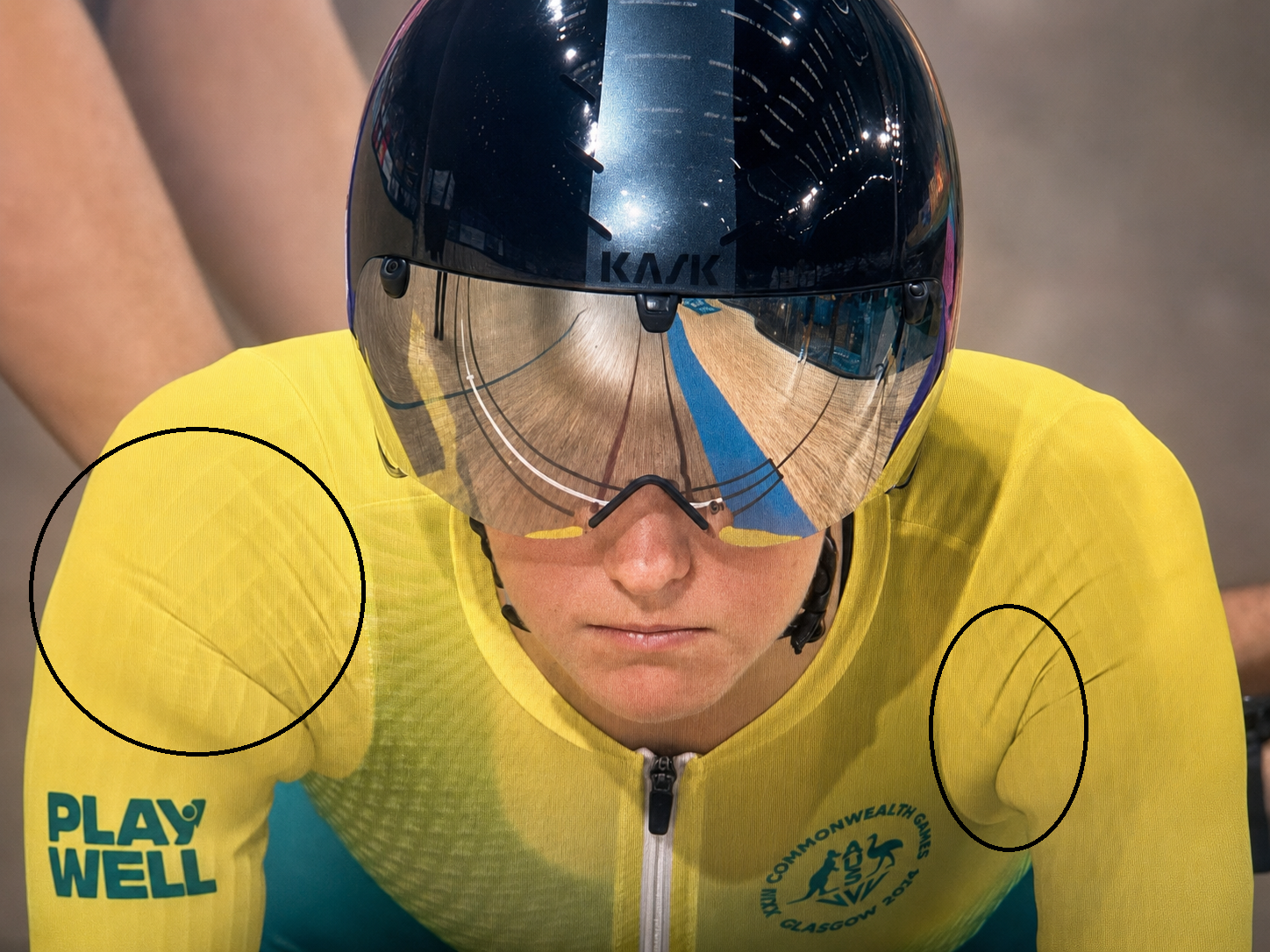
Felicity Wilson-Haffenden had qualified fourth fastest for the women's individual pursuit at the Glasgow 2026 Commonwealth Games when her result was removed. The strapping around her shoulder was judged to have modified her morphology. Sophie Edwards was also disqualified after additional padding was found inside her helmet.
Both decisions followed random post-race inspections. Both riders had competed in Australia's gold-medal-winning team pursuit the previous day, when the Australian team said no objection had been raised about either arrangement.
That earlier use did not make either setup compliant. UCI regulation 1.3.001 places responsibility for compliance on riders and teams, gives commissaires discretion to reject equipment and expressly offers no protection simply because it has been used previously.
But when the same respective arrangements pass through one event and produce disqualifications in another, the control process has still failed somewhere. The question is not whether an infringement overlooked once must continue to be overlooked. It is why questions capable of being identified and resolved through a brief pre-race check were allowed to decide the result afterwards.
The Australian cases attracted attention because they changed the individual-pursuit results, but they also exposed a wider uncertainty. Other equipment and clothing configurations seen during the Games appeared capable of raising similar technical questions without any obvious intervention. From outside the control process, it was impossible to know whether they had been assessed or simply not selected for scrutiny.
A technical rule does not create fair competition simply because it exists in the rulebook. Its value depends on whether comparable cases are identified and treated consistently.
When Detection Becomes Part Of The Competition
Federations know the regulations. They study the wording, the clarification material, previous decisions and what has passed through earlier competitions without objection. Much legitimate technical development takes place close to the boundary between what is clearly prohibited and what remains defensible.
That does not automatically amount to deliberate cheating. It is impossible from outside to know whether either Glasgow arrangement was believed to be compliant, represented an aggressive interpretation or had simply not attracted scrutiny before.
The wider incentive is more important. When a rule is broad and inspection is intermittent, compliance can become a risk calculation: not only whether an arrangement is permitted, but how likely it is to be challenged.
That can disadvantage the teams applying the most cautious interpretation. If pushing an uncertain boundary carries no consequence whenever the arrangement escapes inspection, the probability of being checked becomes part of the performance calculation. Selective detection can therefore distort competition even when every individual disqualification is defensible.
Consistent enforcement does not mean allowing one infringement because another was missed. It means removing the potential reward for avoiding scrutiny.
Broad Rules Require Consistent Interpretation
The morphology rule has to be broad. A bottle beneath a skinsuit, an aerodynamic insert and a substance applied to the body can all change a rider's shape through different means. Naming and measuring every possible method would only create new loopholes.
UCI regulation 1.3.032 states that clothing and other items worn by a rider "may not modify the morphology of the rider". It also prohibits non-essential elements added on, beneath or within clothing, including materials applied to the skin or clothing.
An element is considered non-essential when it has no exclusively clothing or protective purpose, or is not strictly necessary for the item to function. What the regulation does not provide is a dimensional test. There is no published thickness limit for medical strapping and no prescribed measurement for deciding when support becomes a morphological modification.
That flexibility is necessary, but it leaves borderline cases dependent upon judgement. Medical tape can have a genuine therapeutic purpose without every possible application being compliant. A reasonable operational distinction would be between flat, skin-conforming tape that does not materially change the rider's contour and layered padding or structured bandaging that visibly does.
The latter should require declaration before racing. A dressing needed after a crash, or support required because of an injury, could then be assessed on both medical and technical grounds and recorded for the remainder of the competition. Medical necessity should not create an automatic exemption from the technical rules, but riders should not discover after racing that treatment applied by their medical staff has crossed an undefined boundary.
Edwards's helmet raised a more direct issue. Regulation 1.3.031 requires a helmet to be correctly adjusted, prohibits elements being added or removed in terms of its design or form, and permits only accessories approved by the manufacturer.
Helmet fit still requires some nuance. Smaller riders may use a thin bandana or skullcap beneath a time-trial helmet, particularly where a manufacturer offers fewer shell sizes than it does for a conventional road helmet. That is different from using substantial additional material to fill the space inside an oversized helmet or alter its position.
The answer is not a universal thickness limit for headwear. Where the relationship between the helmet shell and the rider's head suggests a sizing issue, officials can check the helmet size, compare its internal padding with the manufacturer's approved configuration and establish whether it fits correctly. Wilson-Haffenden's strapping required an interpretation of morphology and medical purpose. The additional helmet padding could be assessed against a more specific configuration and safety requirement. The first was clearly visible; the second would require a closer fit check once anything unusual had been identified.
Ten Seconds Before The Start
Consistent enforcement does not require every millimetre of every rider and bicycle to be remeasured before every ride. A brief visual screen in the call-up area, perhaps no more than ten seconds, would identify many visible anomalies and allow anything unusual to be examined before the rider is released.
Wilson-Haffenden's shoulder arrangement was sufficiently obvious to raise the morphology question at a glance. An unusually built-up shoulder, an apparently poor-fitting helmet, an unusual relationship between the rider's head and the helmet shell or another visible change to the rider's outline should trigger a closer look. An unknown brand of equipment. Most riders would pass through immediately. Only the exceptions would require assessment.
- 1. Screen: Briefly check the rider and equipment in the call-up area.
- 2. Escalate: Examine only a visible anomaly or an arrangement declared by the team.
- 3. Decide: Use a measurement, approved manufacturer configuration or the event's designated technical authority, depending on the rule.
- 4. Record: Retain the decision and photographs throughout the competition. Any material change requires another inspection.
This would make responsibility clearer on both sides. Teams intending to use a specific item of equipment, unusual medical support, headwear or another contentious arrangement would have an accessible route to declare it. The event's technical delegate or an authorised member of the commissaires' panel would make the decision. Once recorded, that decision would remain available across events and sessions unless the arrangement changed.
It would not amount to permanent approval, nor prevent post-race inspection. Random checks remain necessary for concealed infringements, equipment altered after inspection and deliberate circumvention. They are a much less satisfactory first point of control for something visible, stable and capable of being corrected before competition.
The UCI's LA28 Track Equipment Registration Procedure already reflects the principle of establishing and recording eligibility before critical Olympic equipment is used. Event-level checks of any form of equipment or setup are a different task, but the governance principle is the same: resolve compliance before it becomes decisive after the result.
Consistency Is Stronger Enforcement
None of this requires weaker rules. Track cycling needs regulations broad enough to address methods that have not yet been anticipated, and teams should remain responsible for what they present for competition. But broad discretion has to be supported by a control process capable of applying it consistently.
Good technical control should not be judged by how many riders are disqualified. It should be judged by whether genuine infringements are detected, comparable cases receive comparable decisions and visible problems are resolved before they change a result.
Teams will continue to explore the boundaries because elite sport rewards every legitimate advantage. The purpose of pre-race screening and recorded decisions is not to prevent commissaires from disqualifying riders. It is to remove the advantage of escaping scrutiny and ensure that the chance of being inspected is never part of the performance calculation.


