In a discipline where careers are often brutally short, that alone demands attention. This is not a retirement piece. She is still racing. That is precisely the point.
The Constant in Spanish Sprinting
Casas was born in 1988 in Vila-seca, Catalonia. She emerged onto the international scene in the late 2000s, a period when Spanish track cycling was searching for stability and identity in the sprint events.
Spain has, historically, leaned more heavily towards endurance on the track. In women’s sprinting in particular, depth has been thin to non-existent. For much of her career, Casas has effectively been the name in Spanish women’s sprinting.
One rider. Repeatedly on start lists. Often alone.
That matters more than it appears on paper.
Sprint cycling is rarely built in isolation. It thrives on internal rivalry, on multiple athletes pushing each other in training, on a domestic calendar that sharpens race craft. Nations such as Great Britain, Germany and the Netherlands have long understood this. Spain, for extended periods, did not have that layered infrastructure in Women’s Track Cycling, let alone sprinting.
And yet Casas remained.
She qualified. She raced. She adapted.
Achievements Beyond Longevity
While Casas' career is often discussed through the lens of longevity, it would be incomplete to view it solely through that prism. She qualified for the Rio 2016 Olympic Games, where she achieved an Olympic diploma, and has won eight UCI Track Cycling World Cup medals across team and individual events, including gold, silver and bronze. She also became the first Spanish female sprinter to win a World Cup silver medal in the keirin.
At European level she has reached the podium three times, winning one silver and two bronze medals in the keirin and team sprint.
Those results represent one of the most decorated records in the history of Spanish women's sprint cycling.
Racing Through Eras
UCI Track Cycling World Championships fields have changed dramatically since Casas first pinned on a Spanish skinsuit at elite level.
She has raced against the likes of Victoria Pendleton, Anna Meares, Shuang Guo and Natallia Tyslinskaya. She lined up during the dominance of Kristina Vogel. She navigated the post-Rio transitional period and now competes in a landscape shaped by riders such as Kelsey Mitchell and Emma Finucane.
That is three distinct competitive generations.
Very few sprinters bridge even two.
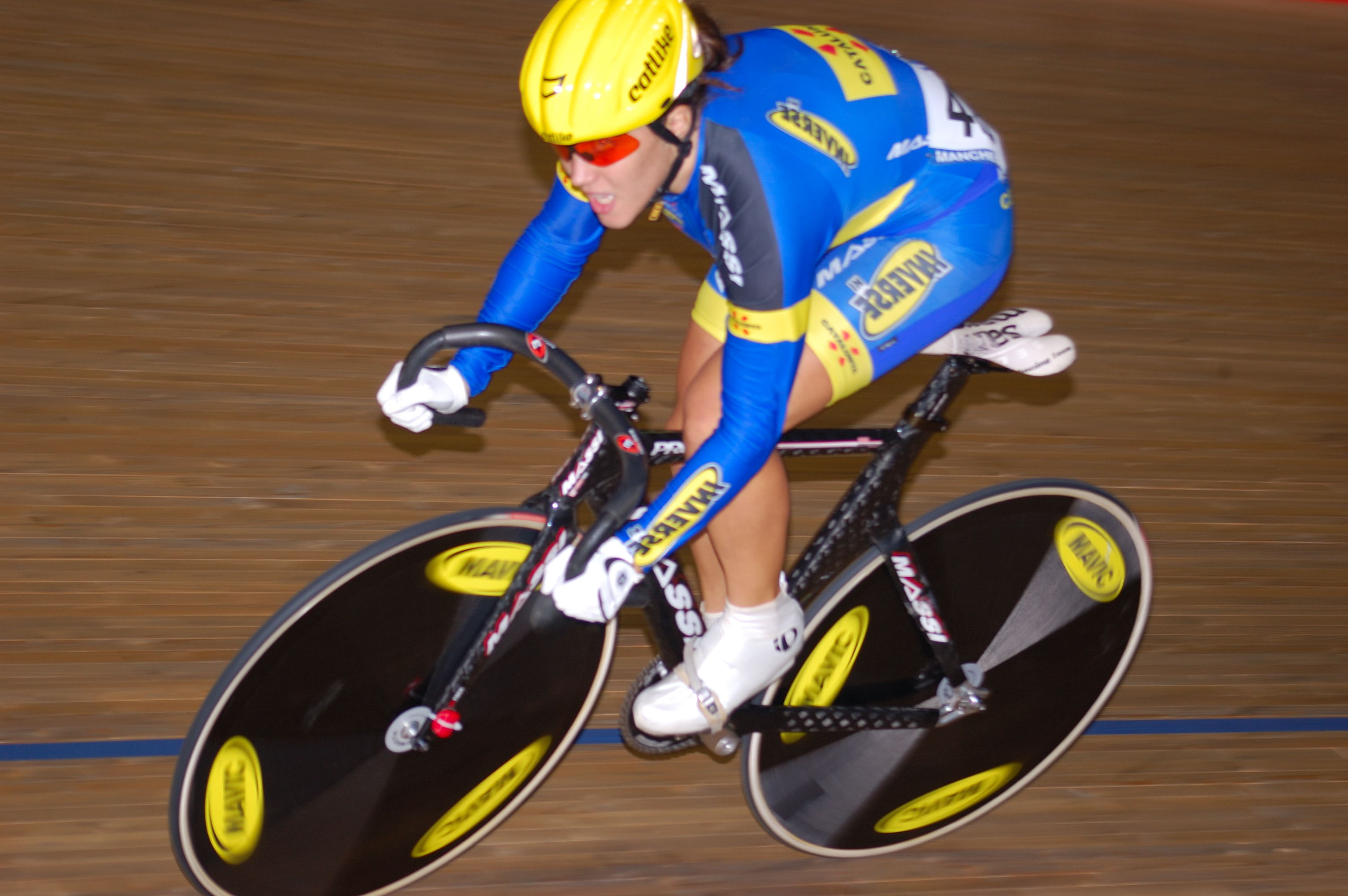
Equipment evolved around her. Early in her career, steel handlebars and simpler cockpit setups were common and everybody had a Casco Warp. The sprint bike has since become a fully integrated aerodynamic weapon, refined in wind tunnels and CFD simulations.
The keirin itself has shifted in rhythm and tactical interpretation. World Cups became Nations Cups and World Cups again. Champions Leagues and Revolution series proved to be anything but their namesakes and disappeared in calamity. Olympic qualification systems have tightened and expanded in cycles.
Through all of it, Casas has remained relevant.
Not surviving. Competing.
The Quiet Art of Improvement
What makes her story compelling is not longevity alone. It is trajectory.
Most sprint careers follow a familiar pattern: a rapid ascent fuelled by neuromuscular sharpness, a peak in the mid-to-late twenties, then a plateau or decline. The margins in sprinting are unforgiving. Reaction times slow. Maximal power drifts. Recovery lengthens.
Casas has not followed that script.
Her 200m qualifying times have edged downward across cycles. Her tactical reading of the keirin has matured. Her ability to handle pressure rounds has sharpened rather than dulled.
Reaching a keirin final at a major championship for Spain is not merely participation. Within her context, it is close to a medal in impact. For nations without depth, a final represents validation of years of structural persistence.
That is where understanding context becomes essential.
A Career Without the Safety Net
When you race within a powerhouse sprint nation, elimination in a quarter-final can be disguised by internal competition. There are training partners who replicate world-class speed every week. There are biomechanical teams refining start positions. There is depth that cushions individual fluctuation.
Casas’ environment has not consistently resembled that.
For extended stretches, she has effectively carried the Spanish women’s sprint flag alone at elite level. That brings pressure. It also brings isolation.
Yet her progression has been steady rather than spectacular. There has been no sudden breakthrough season. No fairy-tale arc. Instead, there has been incremental gain.
In modern high-performance sport, incremental gain sustained over twenty years is arguably rarer than a single championship victory.
Helena Casas - Selected 200m Time Trial Results
2007 UCI Track Cycling World Championships – Palma de Mallorca
200m Time Trial – 12.596s
2017 UCI Track Cycling World Championships – Hong Kong
200m Time Trial – 11.761s
2025 UCI Track Cycling World Championships – Santiago de Chile
200m Time Trial – 11.197s
2026 UEC Track Cycling European Championships – Konya, Turkiye
200m Time Trial – 10.845s
Measuring Success Differently
How do we measure greatness in sprint cycling?
If the metric is rainbow jerseys, the list is short and brutal. If the metric is Olympic medals, it is even narrower.
But what if we measure:
- Years spent at elite international level.
- Competitive presence across multiple Olympic cycles.
- Personal best improvement in the mid-30s.
- Representation of a nation with limited sprint infrastructure.
By those measures, Casas’ career becomes unusual.
How many riders can say they have lined up against nearly every world champion of the last twenty years and are still present on start lists today?
Very few.
The Cultural Shift in Spanish Track Cycling
Juan Peralta represents something important in this conversation.
A former elite sprinter, Peralta transitioned into leadership within Spanish track cycling with lived experience rather than bureaucratic distance. His appointment signalled more than a staffing change. It suggested a shift in philosophy.
Athlete-led insight. Energy. Modern sprint understanding.
There is a noticeable difference in tone around the Spanish camp in recent months. Team spirit appears sharper. Morale feels lighter. Communication seems clearer. The atmosphere has the feel of a group that believes in its direction rather than one navigating internal inertia.
Those who remember the era under Salvador Cabeza de Vaca before London 2012 recall a sense of unity and competitive clarity. For years afterwards, that cohesion felt diluted. The structure remained, but the spark was inconsistent.
Peralta’s tenure has brought a breath of fresh air without grand statements. The change has been cultural rather than rhetorical.
And that matters profoundly for an athlete like Casas.
Helena Casas as Institutional Memory
If Juan Peralta represents new leadership energy within Spanish track cycling, Casas represents continuity.
Her daily training environment has long been based within the Catalan track cycling system in Barcelona, reflecting the broader reality of Spanish track cycling: a landscape that has often been shaped by strong regional programmes rather than a single centralised structure.
For Casas personally, that environment has clearly worked. It has allowed her to build a career of remarkable longevity while continuing to improve well into her thirties.
But it also highlights one of the structural questions facing Spanish sprint cycling in the years ahead. As the sport evolves, greater coordination between regional development and national high-performance leadership could prove decisive.
In that context, the eventual integration of Casas’ experience into a wider national structure alongside figures such as Juan Peralta could prove hugely valuable. Few athletes understand the realities of Spanish sprint cycling more deeply, and fewer still have lived through its different eras from the inside.
The Age Question
Sprinting in the mid-30s is unusual. Not impossible, but uncommon.
The neuromuscular demands of the discipline are extreme. Peak force production, reaction timing and maximal cadence are often cited as age-sensitive variables. Recovery patterns change. Injury risk shifts.
Yet modern conditioning, improved recovery science and smarter periodisation are extending elite windows.
Casas’ continued presence suggests that experience and tactical intelligence can offset marginal physiological drift. In keirin racing especially, reading the derny pace, positioning before the final lap and choosing the correct wheel often matter as much as raw wattage.
Could she continue another Olympic cycle?
The answer depends on support, health and motivation. But history suggests she adapts well to change.
Catalonia and Identity
There is also a regional dimension.
As a Catalan athlete representing Spain on the world stage, Casas has carried dual visibility. Within Catalonia, she stands among the most recognisable track cyclists of the modern era. Whether statistical analysis crowns her the greatest Catalan track cyclist can be debated. In terms of longevity and consistent international representation, her case is strong.
For young female riders in Spain and Catalonia, visibility matters. Seeing someone repeatedly on international start lists shifts perception of what is possible.
Medals inspire. Presence normalises.
Casas has normalised Spanish women’s sprinting at international level.
There is also a quieter layer to Casas’ career that rarely makes headlines. In parts of Spain, particularly outside elite sporting environments, power sport for women has not always been instinctively embraced. The image of a female sprinter lifting heavy in a gym, training explosively and embracing physical strength still draws occasional raised eyebrows in 2026. Those attitudes are fading, but slowly. Casas has not only raced international champions; she has, in small ways, helped normalise the idea that strength, speed and sweat belong to Spanish women too.
What Legacy Really Means
Legacy in sport is often simplified. It is easier to point to medals than to systems.
If Casas retired tomorrow, she would not leave behind a cabinet of world titles. But she would leave behind nearly two decades of international presence, incremental improvement and resilience.
More importantly, she would leave behind proof that Spanish women’s sprinting belongs on the world stage.
If she transitions into coaching or technical integration within a Peralta-led structure, the impact could multiply. She would bring credibility to a pathway that historically lacked depth. She could mentor young sprinters not just in wattage and starts, but in how to survive the psychological grind of international competition.
The combination of Peralta’s modern leadership and Casas’ lived sprinting experience could represent the most meaningful structural shift in Spanish women’s track cycling in a generation.
The Subtle Revolution
Not all change in sport is loud. Sometimes it is the quiet replacement of inertia with energy. Sometimes it is the decision to trust former athletes with system design. Sometimes it is the recognition that longevity itself holds knowledge.
Spain’s track cycling programme appears to be moving towards a culture built on belief rather than hierarchy. That is rarely accidental. It reflects choices.
If those choices include integrating Casas into leadership or coaching once her racing career concludes, Spain could transition from relying on a single female sprinter to developing genuine depth.
That would be a legacy worthy of twenty years on the boards.
The Final Question
How long can she continue?
Perhaps the more interesting question is not how long she can race, but how long her influence can extend.
In a sport that celebrates explosive peaks, Helena Casas represents something different: endurance within sprinting. Persistence within power. Improvement within limitation.
She has raced across eras. Against champions. Through structural and cultural change. Through equipment revolutions. Through generational shifts.
And she is still here.
In many ways, that is rarer than gold.


