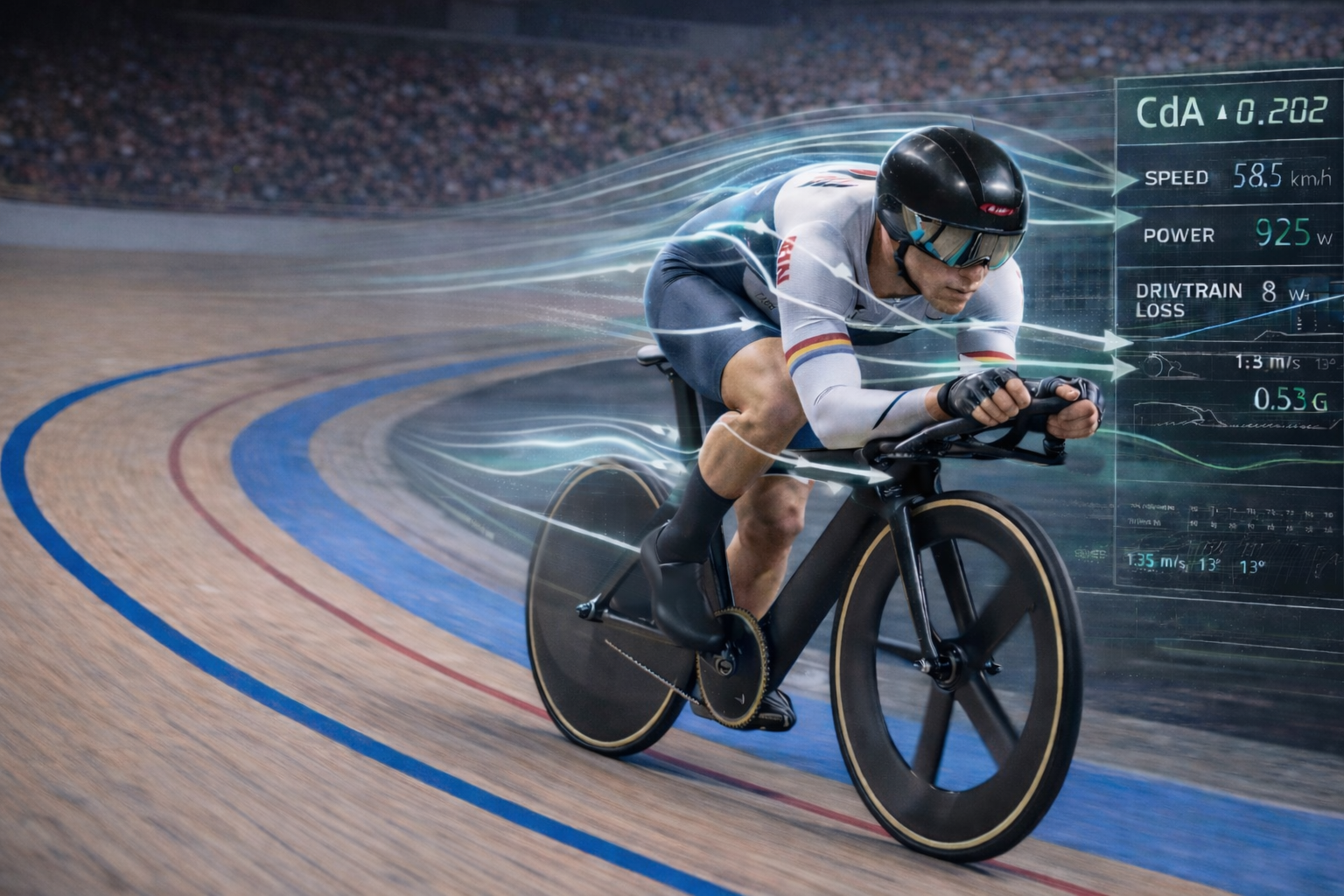
In an era defined by marginal gains, wind-tunnel optimisation, and revolutionary equipment, Lap 1 remains track cycling’s unsolved riddle.
Let’s break down why.
The Standing Start Is a Physics Problem, Not an Aerodynamic One
When a Lap 1 rider launches from the start gate, the challenge isn’t slicing through the air — it’s overcoming inertia. From zero velocity, aerodynamic drag contributes less than 5 % of the total resistive forces during the first second. The real battle is internal: torque generation, traction, mechanical stiffness, and drivetrain efficiency.
Read More - The Standing Start: Physics vs Aerodynamics in Track Cycling
The Start Gate Has Become the Great Equaliser
For all the technology that has transformed track cycling since Beijing 2008 — from 3D-printed bars to CFD-designed suits — the start gate remains one of the least appreciated performance variables. It’s the interface between a 2,000-watt athlete and a stationary 8 kg bike restrained by hydraulics and electronics. And it has quietly become the single largest normalising factor in Lap 1 performance across nations.
Read More - Track Cycling Starts- Start Gate Has Become the Great Equaliser
Gear Evolution Has Outpaced Human Acceleration
In 2008, Jamie Staff launched Great Britain’s team sprint from a 98-inch gear — big for the era, but modest by modern standards. Today’s Lap 1 specialists routinely push 102–106 inch gears, sometimes higher in altitude venues. This shift has transformed the first lap from a power sprint into a torque-limited launch, where human biomechanics, rather than power production, have become the bottleneck.
Read More - Why Bigger Gears Don’t Mean Faster Starts | Track Cycling Physics
Launch Aerodynamics vs Launch Posture
When the starter tone sounds, the Lap 1 rider must produce the highest possible forward impulse from a near-stationary position — yet modern riders begin that effort in a position designed for 75 km/h aerodynamics, not 0 km/h biomechanics. This tension between drag reduction and force production has become a defining limiter in Team Sprint evolution.
Read More - How Aerodynamic Positions Reduce Start Power in Track Cycling
Rider Typology Shift — From Start Specialists to System Enablers
In the early 2000s, the Team Sprint opener was a pure specialist — a rider selected for one purpose: to produce the most violent acceleration ever recorded on a velodrome. By contrast, the modern Lap 1 rider has become a system component, optimised not for their own split, but for what they deliver to Lap 2. That shift in physiology, training, and team strategy explains why Lap 1 performance has remained static even as total times have dropped by nearly two seconds.
Read More - How Team Sprint Riders Evolved | From Power Starts to System Speed
Track Conditions and Environmental Physics
Even when two riders produce identical power, the velodrome itself can make them appear worlds apart. Air density, temperature, humidity, surface stiffness, and even track geometry interact to determine how efficiently watts convert into metres per second. When comparing Jamie Staff’s 17.1 s opener in 2008 to Roy van den Berg’s 17.2 s in 2024, the environmental context is not a side note — it’s central physics.
Read More - How Air Density and Track Surface Affect Lap 1 in Track Cycling
Reaction Time and Gate Technique Have Maxed Out
When Jamie Staff launched from the gate in Beijing 2008, human reaction time still had untapped potential. By Paris 2024, every elite starter had already reached it.
The limiting variable is no longer how quickly a rider reacts — it’s what happens in the mechanical system between that neural impulse and the first centimetre of motion.
Read More - Why Track Cycling Reaction Times Can’t Get Faster | Physics Explained
The Paradox of Progress — Collective Gains, Individual Plateaus
Track cycling has never been faster, yet the opening lap of the Team Sprint has stood still for almost two decades. That paradox reveals something profound about modern performance: every improvement that accelerates the system makes the individual first mover slightly slower.
Read More - Lap 1 Plateau Explained | The Paradox of Progress in Track Cycling
What Would It Take to Break 17.0 Again?
Seventeen years after Jamie Staff’s 17.1 s opener, the long-standing barrier was finally broken when Leigh Hoffmann recorded 16.886 s in Paris 2024. Yet the question remains: what would it take for such speed to become repeatable and beneficial to the overal Team Sprint time? The answer isn’t more watts — it’s new physics, new interfaces, and new ideas.
To cut even another 0.2 s — and make sub-17 laps sustainable — the system must evolve beyond today’s mechanical and regulatory boundaries.
Read More - What Would It Take to Break 17.0 Again | Future of Track Cycling
Team Sprint Tyre Selection and Pressure Strategy for Lap 1 vs Lap 2/3
In track sprinting, tyres are more than contact points — they’re torque translators, traction controllers, and efficiency filters. The correct combination of compound and pressure determines how effectively a rider’s power leaves the gate and how cleanly it carries speed into the flying laps that follow. In Team Sprint events, the demands on the tyres evolve every lap. The Lap 1 opener faces explosive gate torque and low-speed traction challenges, while the Lap 2 and Lap 3 riders operate in the high-speed, low-slip regime where rolling resistance dominates. One setup cannot serve both roles equally well.
Read More - Tyre Selection & Pressure Strategy | Track Cycling Lap 1 vs Lap 2/3
The Hoffman Paradox: Why a Sub-17 Lap Doesn’t Always Win
When Leigh Hoffman stopped the clock at 16.886 seconds for Lap 1 of Australia’s Team Sprint qualification at the Paris 2024 Olympics, it looked like a breakthrough moment.
After seventeen years, someone had finally broken the 17-second barrier for a standing-start lap. Yet the result proved that physics and pacing still rule the stopwatch — not raw speed.
Australia’s run of 42.072 s was only third fastest in qualifying, despite the fastest opening 500 m of the field (28.912 s). Why? Because the Team Sprint is a system, not a sprint.
Read More - The Hoffman Paradox | Why a Sub-17 Lap Didn’t Win in Paris 2024
What This Means For Equipment Choices
Lap 1 is not solved by buying the most aerodynamic part in isolation. It is a torque path.
The chain, sprocket, chainring, bottom bracket, crank, tyre, front wheel, bar and stem all sit between the rider and the track. In the opening seconds, each one has to deal with force before it deals with speed. Flex, slip, poor engagement, unstable tyre pressure or a cockpit that encourages the wrong launch posture can all make a powerful rider less effective.
The fastest team sprint bikes are not simply the lowest-drag bikes. They are bikes that let the first rider apply force cleanly, let the second rider receive speed without disruption, and let the third rider finish the race without paying for instability created at the start.
For sprint programmes, that changes the equipment question. The aim is not to build the most extreme Lap 1 machine. It is to build a system that turns the start into usable speed and is the reason why many national federations are looking at different concepts of bike design for each role within the team sprint trio for Los Angeles.