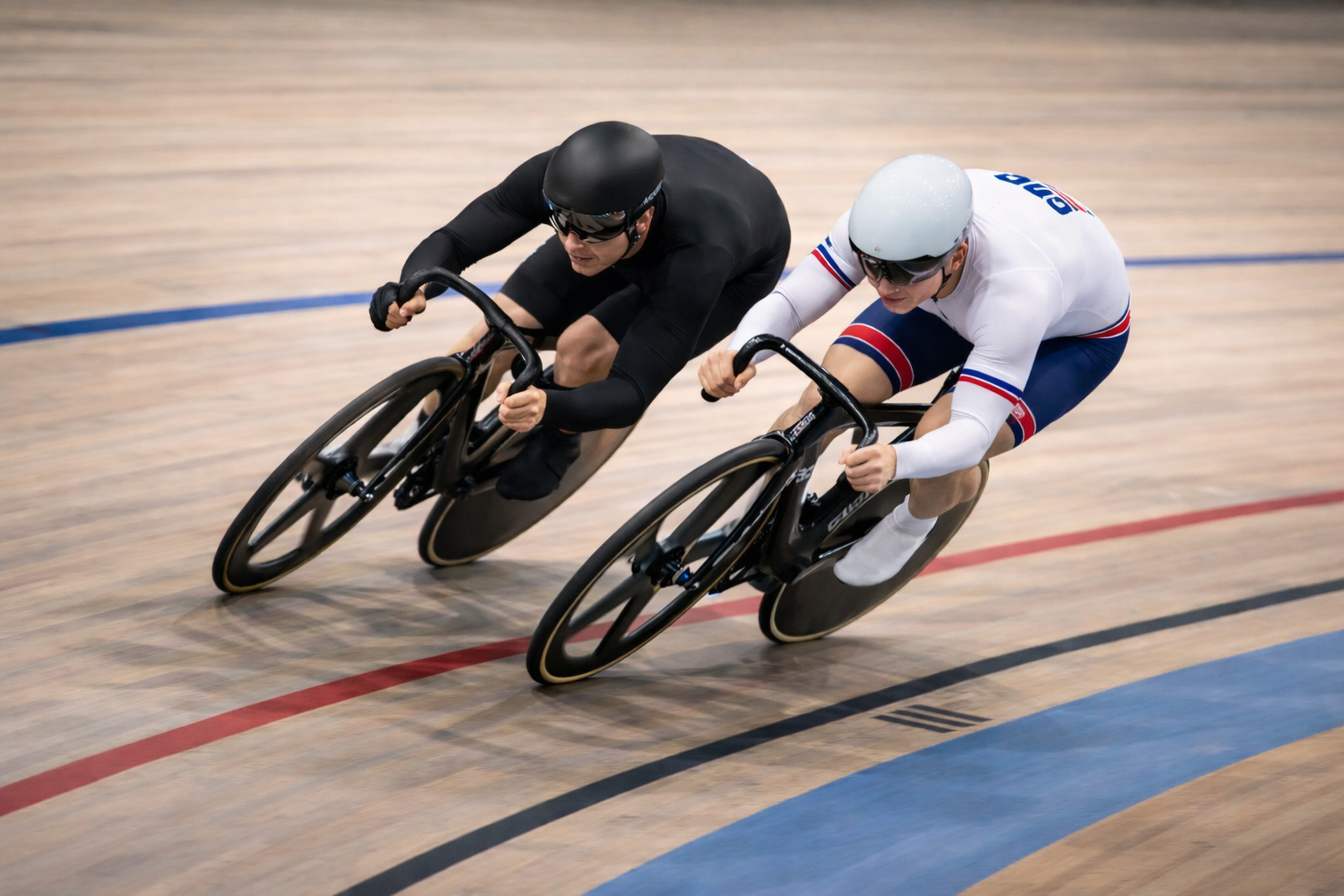
There is a point in a hard sprint where the romance drops away.
At the start, everything feels right. The gear picks up, the body feels violent in a useful way, and the bike answers back. For a few seconds, sprinting seems as simple as people like to imagine it: make the biggest effort, hit the pedals hardest, be more explosive than the rider next to you.
Then the effort changes shape.
The speed is still there, but it is no longer easy speed. The gear does not feel like something being launched so much as something being managed. The body has to stay organised. The line has to stay tidy. The rider is no longer just creating speed, but trying to hold onto it.
That is the part of sprinting that matters most, and the part the sport still does not always describe honestly enough.
A newly published study "Sprint Physiology and Performance Determinants in Elite Track Cyclists" helps put proper language around that reality. Looking at 15 elite male track cyclists across maximal efforts of 3, 8, 12 and 60 seconds, the authors found that the shortest efforts were dominated by alactic energy supply, while longer efforts relied increasingly on lactic contribution and the ability to sustain output under fatigue. Their conclusion was sensible rather than dramatic: sprint performance still begins with power, but it does not survive on power alone.
Where the sprint really begins
Anyone who has raced enough already knows this.
They know it from the kilo rider who looks magnificent in the first half and ordinary in the last quarter. They know it from the Keirin attack that flies off the front when the derny leaves the track but loses momentum when it matters. They know it from the sprinter who can light up a warm-up area with one savage effort, then struggles to reproduce the same authority later in the day.
The problem is not that the sport misunderstands sprinting on the track. It is that it often misdescribes sprinting off it.
Sprint cycling still gets sold in the cleanest possible language. Big gear. Big jump. Big watts. That version is appealing because it sounds decisive. It gives riders a clear identity and gives spectators a simple story. But it also encourages a lazy understanding of performance. It suggests that the event belongs to one quality, when in reality it usually belongs to the rider who can do more with that quality than produce one spectacular beginning.
Peak power matters. Of course it does. But peak power is often the entry fee, not the whole performance.
The danger of training only the flattering part
Training tends to follow identity.
If a rider thinks sprinting is mainly about the first hit, most of their work will drift towards the first hit. Plenty of freshness. Plenty of recovery. Plenty of short efforts that keep everything looking sharp. Enough to feel fast, enough to confirm the image, enough to leave the session believing the work is good.
There is nothing wrong with that until it becomes the whole plan.
The race does not care how flattering your best moment is. It cares how complete your effort is.
That is the useful lesson here. Not "be less explosive", and certainly not "train like an endurance rider". The real lesson is to stop building everything around the part of sprinting that feels best.
A rider who can produce one beautiful opening is interesting. A rider who can still produce something useful once the effort turns heavy is dangerous.
That is the shift many riders need to make. Less admiration for the jump on its own. More attention to what happens after it.
A flying 200 is not a kilo
Different sprint events ask different questions, and that is where the discussion becomes practical.
A flying 200 still rewards top-end speed, timing and the ability to arrive at the line fully committed. No amount of generic conditioning will replace that. But even there, the ride is not won by one isolated flash. It is won by how well speed is built and carried.
A kilo is harsher and more honest. It has never been a celebration of the start alone. Riders still need the opening force, but the event punishes anyone who confuses a brilliant beginning with a complete performance. The gap usually appears later, when the bike has to keep moving through discomfort rather than through pure aggression.
The team sprint exposes the same truth in a different way. The first rider may live closest to the old stereotype of sprinting as pure ignition. By the second and third laps, that explanation becomes less convincing. At that point the event is asking who can keep producing clean force when the body is under real pressure.
That is why event-specific thinking matters so much. "Sprinters need power" is true, but too vague to be useful. What kind of power? For how long? After what lead-in? Repeated how often? Under what fatigue? Those questions are where real progress begins.
What your fade is trying to tell you
Most riders can learn a great deal just by becoming more honest about how their efforts fall apart.
- Do you lose speed suddenly or gradually?
- Does the gear feel too big because of strength, or because posture and rhythm are collapsing?
- Do you fight the bike instead of driving it?
- Do you tighten under pressure?
- Do you produce impressive peak numbers but mediocre complete rides?
Those are not minor details. They are often the entire story.
A lot of improvement comes not from discovering some magical new session, but from identifying the exact point where your sprint stops being effective and then building training around that weakness.
That is the part many riders skip, because it is less flattering. It is far nicer to leave the track feeling quick than to leave with a clearer understanding of what needs work. But one feeling feeds the ego and the other feeds performance.
The stronger riders usually choose the second.
Recovery is part of sprint performance
There is another point riders do not always enjoy hearing: recovery belongs inside sprint performance, not outside it.
A rider who is always slightly under-recovered may still be able to produce one decent effort. What they often lose is the ability to train the full shape of the event well. The session becomes a rehearsal of the opening only, because they do not arrive with enough freshness to do quality work in the deeper, more demanding part of the sprint.
That is not toughness. It is just poor preparation disguised as hard work.
For self-coached riders, this matters even more. Limited training time makes session quality more valuable, not less. If you only get a few proper chances each week to do sprint work, it makes little sense to spend them endlessly proving you can still produce one good early effort while ignoring the part of the ride that actually costs you results.
Good recovery does not make a rider soft. It gives them access to the work that matters.
What riders can apply straight away?
Keep the explosive work in the programme. Nothing here says otherwise, but stop judging a sprint only by the first number. Train your actual event, not the stereotype of your event and study how you fade, because that is usually where the most useful clue is hiding. Make sure you are fresh enough to train the difficult part of going fast, not just the easy part.
Questions worth asking after your next sprint session
Where did the ride stop feeling clean?
What changed first - cadence, posture, force, line, or confidence?
Was the gear right for the full effort, or only for the opening phase?
Did I train the part of the sprint that decides my race, or just the part that flatters me?