Matthew Richardson is in Japan. So is Harrie Lavreysen. Joe Truman has gone back, and on the women's side Ellesse Andrews, Hetty van de Wouw and Mathilde Gros have joined them. Put those six names together and the instinct is to read the story the way modern track cycling usually invites it to be read: medals, titles, speed, hierarchy, the familiar order of who has won what and who is expected to win next.
Japan does not really need to arrange the story that way.
For a few months, the indoor sprint world is not quite the centre of events. The polished international calendar, the rhythm of championships, the cleaned-up television version of keirin that much of the sport now treats as standard - all of that looks slightly different when it lands in the country where the event never stopped belonging to its own culture first.
Keirin was launched in Japan in 1948, and JKA still presents it not simply as a race but as a public institution whose revenues support areas including social welfare, sport, education and disaster relief.
Six established champions and contenders have stepped into a system that does not automatically flatter outside reputations.
Japan knows exactly who they are. It just does not need to revolve around them.
The School
The word 'school' sounds almost gentle from a distance. It is anything but. In reality, it tells you something essential about keirin's character. This is not just a run of race appearances. The riders are there for the summer, living inside the rhythm of the sport rather than dropping into it briefly from the outside. The UCI's 2026 announcement makes clear that this is a formal return of international riders under a renewed framework between the UCI and JKA, not an informal sideshow.
And that rhythm is part of the point. Early starts. Roll call. Training. Cleaning. Routine. Repetition. Classroom work. More training. Lights out. On JKA's own description of keirin school, the day begins at 6:30, moves through drills, cleaning duty, hill climbing, lap training, science classes, roller work and race simulation, and ends with lights out at 10:00.
The lesson is not only physical. The sport is teaching discipline before it offers belonging.
In most elite sport now, the athlete arrives as the finished article. They are already the star, the medal winner, the known quantity. Support staff refine the edges, but the athlete's place in the story is secure. Keirin asks for a different posture. It asks the rider to understand that the sport existed before them, that it has its own customs, and that entry is not the same thing as belonging.
You can see why that would appeal to certain riders. You can also see why it might strip away a few comforts. Richardson arrives with that restless energy that seems to carry excitement everywhere he goes. Lavreysen arrives as the most dominant male sprinter of his era. Andrews and Van de Wouw bring top-level finishing speed and championship poise. Gros and Truman return with at least some memory of the environment already in their legs and heads. Yet the point is not that Japan is about to receive six guest stars. The point is that six riders who are used to being understood immediately are entering a place that will judge them by its own standards.
Keirin school, not a summer camp
For riders arriving from the modern international sprint system, keirin school is one of the first signs that this is not simply another race block. The routine is strict, repetitive and deliberately shaping. Early starts, formal discipline, physical work, classroom learning and daily structure all reinforce the same idea: in Japan, keirin is not just something you race. It is something you enter.
The Line
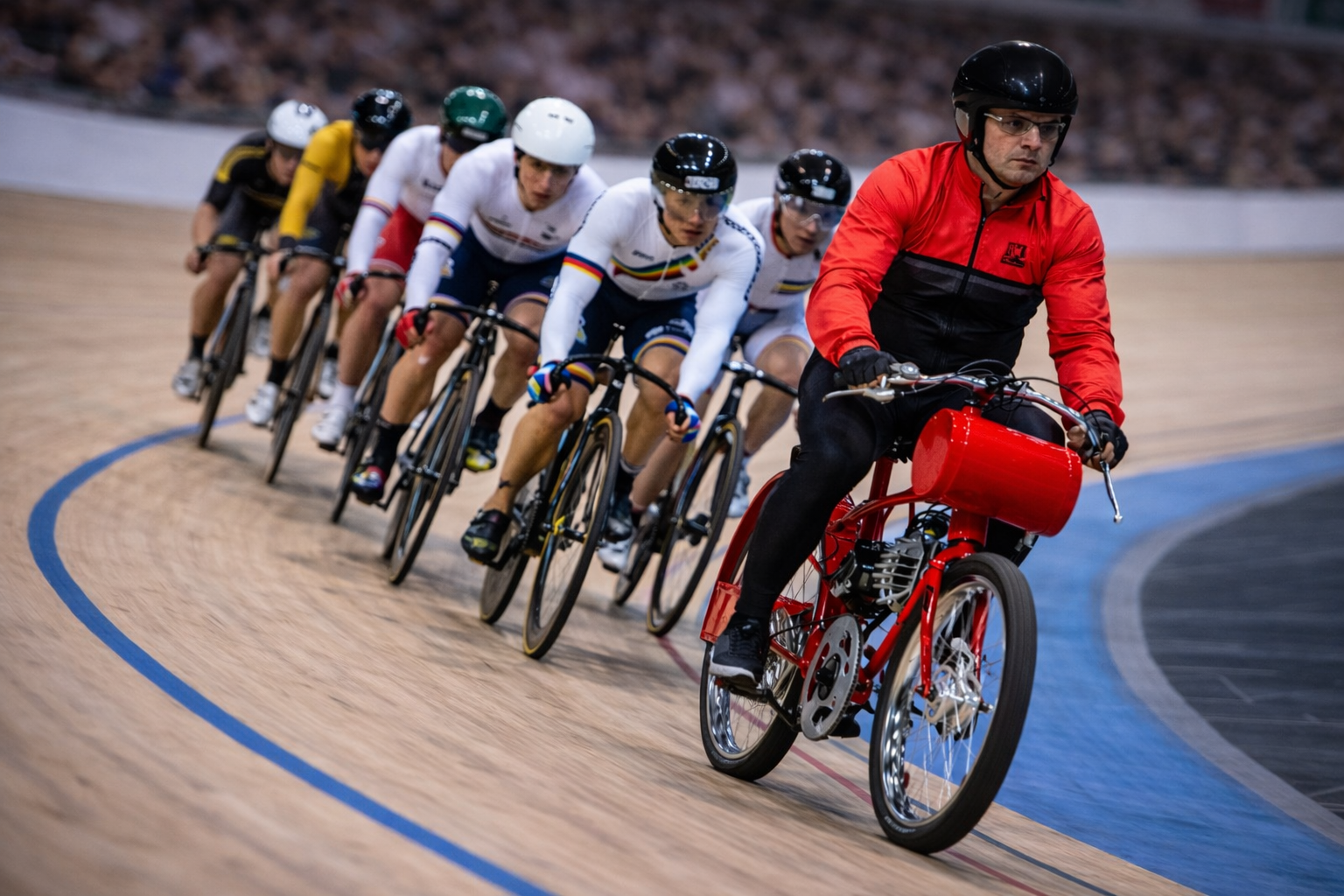
The biggest mistake people outside Japan often make is to assume keirin is just keirin wherever it is raced. It is not. The Olympic event shares a name and an ancestry, but the domestic Japanese form still runs on a different logic.
Part of that logic is visible straight away. Outdoor velodromes. Concrete surfaces. Standardised steel bikes. A different feel to the effort. A different visual feel to the racing. But the real difference is not only in the equipment or the setting. It is in the way the race is understood.
Japanese keirin is a sport of lines before it is a sport of heroes.
JKA's own guide is unusually clear on this point. Riders form lines to strengthen position and make overtaking harder. The second rider in the line protects the leader from behind, blocks rivals trying to move up and can widen the gap to make the chase more difficult. Position is not simply individual. It is social, tactical and often rooted in relationships and trust. Speed alone is not the key to winning; strategy is part of keirin's appeal.
In the international sprint world, individuality is everything: the jump, the lane choice, the timing, the power, the signature way a rider imposes himself or herself on a race. In Japan, individuality still matters, of course it does, but it is mediated through structure. Riders are read through lines, through declared intent, through the shape of the race as much as the violence of the finish.
More than a different bike
The differences are not cosmetic. Japanese keirin still sits in a world of outdoor tracks, racing in all weather, standardised machines and a racing culture in which strategy is foregrounded. Even JKA's beginner guide starts with the point that speed alone is not enough. The event asks different questions, and not all of them are answered by peak power.
That is why "adaptation" feels too small a word for what this summer represents. Adaptation suggests technical adjustment: different bike, different surface, different calendar. All true, but not really the heart of it. The truer word is translation. These six riders have learned to become great in one language of track cycling. Japan is asking whether that greatness speaks clearly in another.
Being a champion is not the same as belonging
That is the question sitting underneath the whole summer.
Not who is strongest. Not even who will win the most. Those are the easy questions, the ones sport always reaches for first. The more interesting one is what remains of a champion when the world that made them legible is no longer doing the work for them.
Lavreysen may find that the calm authority which makes him so formidable in major championships travels well. Richardson may find that his appetite for movement and disruption opens doors in a racing culture that can punish hesitation. Andrews and Van de Wouw may discover new uses for instincts built on the biggest stages in the sport. Truman and Gros may benefit from already knowing that Japanese keirin does not feel like an exotic side road but like a place with its own internal seriousness.
This is not really about predicting the ending. Each of them is entering the same system from a slightly different angle, and Japan will reveal those differences with unusual clarity. The official 2026 cohort itself tells that story: three men, three women, all drawn from the very top end of international sprinting, all entering the same Japanese summer under the same UCI-JKA framework.
Champion versus belonging
Elite sport is full of athletes who can win almost anywhere. Fewer can walk into an established sporting culture and immediately belong. That is what makes this summer so revealing. Japan is not just testing speed. It is testing fluency.
There is a wider track-cycling story in that. Outside Japan, the sport has spent years searching for ways to look more coherent, more meaningful and more alive. It has tried new formats, new branding and new presentation. Japanese keirin has survived by needing less reinvention than that. It remained itself. It stayed attached to place, to audience, to routine, to the stubborn authority of its own habits.
That does not make it perfect, and it does not mean the rest of the world should copy it wholesale. But it does make this summer quietly revealing. When six of the best riders in the modern sprint world go there, they are not being asked to advertise the sport. They are being asked to enter it.
Put all six there at once and the story becomes something else: a rare moment in which elite international sprinting is forced to look at keirin not as its origin myth, but as a living parallel world. Richardson on his own would have been interesting. Lavreysen on his own would have been interesting. The women arriving together would have been interesting. Put all six there at once and the story becomes something else: a rare moment in which elite international sprinting is forced to look at keirin not as its origin myth, but as a living parallel world.
By the end of the summer there will be results to measure, rides to replay and neat conclusions people will want to draw. One rider will seem to have taken to it naturally. Another may look slightly less at ease. That is sport. But the better reason to watch is this: keirin, in its own country and on its own terms, is about to ask six of the most accomplished sprinters in the world a very old question.
Who are you when the sport stops speaking your language first?