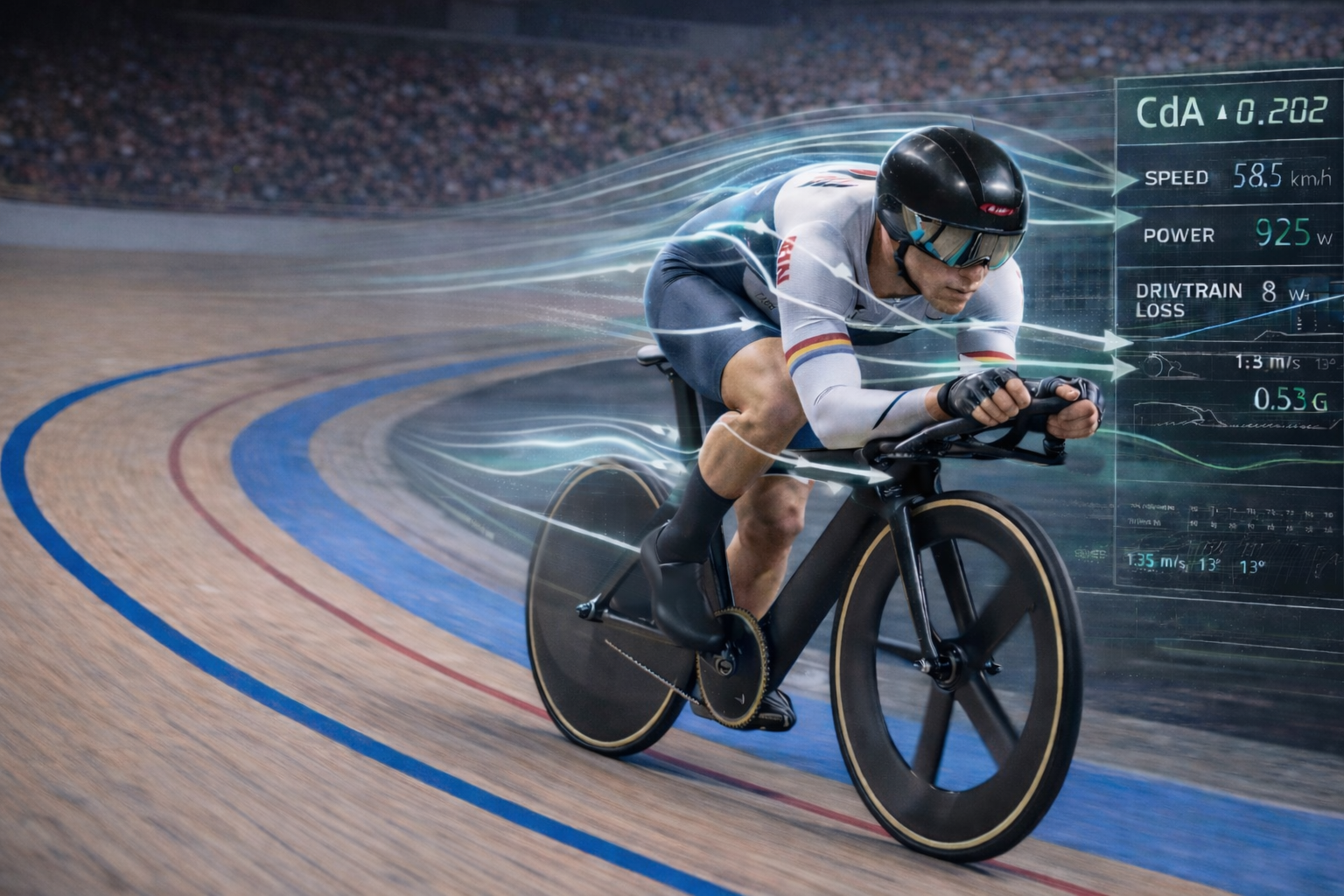
USA Cycling's Project 4:05 was a data-driven initiative built around rider power, aerodynamics and team coordination. It used operations research, mixed-integer programming, real-time analytics and aerodynamic innovation to optimise preparation, team selection and race-day planning.
There is a lazy way to read the story of Project 4:05.
You look at the headline version - Olympic gold, aerodynamics, modelling, data, optimisation - and conclude that it is all very impressive, but mainly relevant to wealthy nations with large staffs, deep rider pools and the budget to turn ambition into infrastructure.
That would be the wrong lesson.
The more useful reading is harder, and perhaps a little less comfortable. Project 4:05 matters not simply because it helped win gold. It matters because it shows what happens when a nation treats team pursuit not only as a training problem, but as a design problem. That is the part smaller nations should pay attention to.
Because many nations outside the major powers are constrained not only by budget, but by the quality and coherence of their decision-making. That is not a criticism of effort. In many smaller programmes there is genuine intelligence, commitment and hard work. What is often missing is not care, but structure: a clear event priority, a settled race model, agreed rider roles, joined-up decision-making and the discipline to stop changing course too late in the cycle.
That, more than anything, is what the American example offers. Not the tunnel itself. Not the software. Not the exact staffing model. The logic.
And that logic is simple enough to state plainly: if you have limited time, limited money and limited depth, you cannot afford to be vague.
You cannot afford to treat selection as reputation. You cannot afford to treat pacing as feel alone. You cannot afford to let aerodynamics sit in one corner, physiology in another and race planning somewhere in between. You cannot afford to arrive at a major championship still learning what sort of team you actually are.
At Olympic level, that looseness is costly.
USA's women were sixth at the 2023 World Championships in Glasgow in 4:12.684, missing the bronze-medal qualification round by 0.159 seconds, and then won Olympic gold in Paris in 4:04.306. That scale of change is why this project has drawn such attention.
A four-kilometre team pursuit is not simply four strong riders doing their best in a line. It is a performance shape. Every choice changes that shape: who starts where, who takes which kind of pull, who can carry speed without over-reaching, who recovers best in the wheels, who destabilises the line when tired, who gives the team flexibility and who gives it risk. The strongest four riders on paper are not always the fastest four in reality.
For nations with limited depth, that is not bad news. It is an opportunity.
Because once you understand that the event is a design problem, not just a fitness test, you begin to see where better thinking can still buy real time.
Not miracles. Not fantasy. But time.
Project 4:05 does not prove that every smaller nation can reproduce USA Cycling's gains.
It does suggest something more practical: that a smaller nation can become harder to beat if it becomes more exact about event choice, rider roles, race modelling and technical discipline.
The First Lesson: Choose Properly
So what would a practical version of that look like for a nation without major-nation money?
It would begin with honesty.
Not optimism. Not slogans. Honesty.
Which event is actually worth building around? How many riders of genuine top-eight or medal-contending standard really exist in that pathway? What is the real depth, not the polite version written in a strategy document? Which technical weaknesses are persistent, and which disappear only in training? Which parts of performance are stable, and which collapse under pressure?
That process sounds obvious. In many programmes it either never really happens, or it happens too late.
A smaller nation cannot afford that softness.
It has to choose. Properly choose.
That may mean accepting that it cannot chase everything. It may mean deciding that the women's team pursuit is a genuine opportunity but the men's is not. It may mean leaning into sprint rather than endurance, or the other way round. It may mean dropping events people are emotionally attached to in order to build one event properly.
None of that is glamorous. But focus is one of the few performance advantages that does not require wealth.
The Second Lesson: Build a Race Model
The next step is to stop confusing training with modelling.
This is where many lesser nations still leave time on the track. Riders train hard. Camps happen. Repetitions are done. Race simulation is mentioned. But nobody has truly built a race model. Nobody has sat down and asked, with enough discipline, what their fastest realistic configuration actually is. Not the most politically comfortable configuration. Not the one that looks nicest on a team sheet. The fastest.
That does not require a seven-figure budget.
It requires a whiteboard, decent data hygiene, intellectual honesty and enough courage to challenge assumptions.
Who is genuinely the best starter? Who is the best stabiliser in the middle of the ride? Who gives the team its highest opening speed but increases late-race fragility? Which rider looks indispensable because of reputation but is awkward in the actual race shape? Which rider is not the strongest individually but makes the team faster because she fits the event better?
Those are difficult questions.
Smaller nations should like difficult questions, because difficult questions are often cheaper than expensive answers.
The Fourth Rider Is Not a Detail
The fourth rider, in particular, matters more than smaller nations often admit.
In major programmes, depth creates obvious selection drama. In smaller programmes, selection can look brutally straightforward from the outside. Three names are fixed. A fourth is needed. End of conversation.
But that is too simplistic.
In a pursuit team with limited depth, the fourth rider is often not just the weakest of four. The fourth rider is the rider who changes the whole system. Change that rider and you change the opening speed the team can tolerate, the contribution balance, the recovery pattern, the pressure on the strongest athlete, the quality of the line in the final kilometre, and the margin for error when the ride gets ugly.
That is not a minor detail. It is the race.
So one of the biggest gains available to smaller nations is to stop treating the last place as an afterthought and start treating it as a systems decision.
Who makes the team fastest overall?
That question must come before "who deserves the ride?" or "who has always been in the group?" or "who looked best in the last camp?" Deserving and fastest are not always the same thing.
Aerodynamics Before Aero Spending
The aerodynamic lesson is just as important, and in some ways more liberating: not all aero gains cost serious money.
Some do, obviously. Wind-tunnel time costs money. Product development costs money. Bespoke skinsuits cost money. But a surprising amount of improvement begins not with spending, but with discipline.
Body-position consistency. Helmet stability. Front-end repeatability. Cleaner equipment setup. Smoother changes. Better line holding. Better spacing. A rider understanding what she actually looks like at race speed, rather than what she imagines she looks like.
Many smaller nations still behave as though aerodynamics begins when an expensive external partner arrives. It does not. Aerodynamics begins when a programme stops being casual.
You do not need a full aero department to build an aero culture. You need standards. You need repeatability. You need somebody in the programme who keeps asking the same awkward questions until they become normal questions.
Is the position stable under fatigue? Is the line still clean at full effort? Does this equipment setup genuinely help, or merely look modern? Have we actually standardised what "good" looks like?
That is not glamorous work. It is simply grown-up work.
Data Only Matters If It Changes Decisions
Smaller programmes often feel behind, so they collect more and more information in the hope that looking modern will eventually make them modern. Power files. Testing blocks. Video. Dashboards. Spreadsheets. Field notes. Then nothing really changes. Selection remains political. Pacing remains instinctive. Technical execution remains uneven. Race plans remain vague.
That is not a data problem. It is a decision problem.
The value of a project such as 4:05 is not that it had numbers. It is that the numbers were tied to race questions: who rides, in what order, for how long, under which constraints, toward what target. That is the standard smaller nations should borrow.
Not more data. Better use of the data they already have.
A lesser nation heading toward LA 2028 does not need to know everything. It needs to know the things that matter for its chosen event. It needs one shared view of rider capabilities. It needs one language for contribution. It needs one race model. It needs one honest process for deciding which riders fit that model and why.
That alone would move some programmes a long way forward.
- Choose one genuine priority event and commit to it
- Build a simple race model instead of relying on feel alone
- Treat the fourth rider as a systems decision, not a leftover place
- Standardise position, setup, line discipline and change quality
- Use existing data to answer race questions, not to fill spreadsheets
- Make every staff member work toward the same event-specific outcome
Alignment Is a Competitive Advantage
And perhaps the biggest lesson of all is that coaches, analysts and support staff must be working on the same problem.
This sounds obvious. In practice it often is not.
In too many systems, the physiologist is solving one problem, the coach another, the mechanic another, the aerodynamic voice another, and the leadership group yet another. Everyone is busy. Everyone is capable. Everyone is slightly misaligned. The result is a programme that feels industrious from the inside and disjointed from the outside.
Riders sense that even when nobody says it aloud.
The best systems are not merely full of expertise. They are aligned.
That may be the most transferable lesson in the whole American example. Not that smaller nations need huge performance departments, but that whatever expertise they do have must point at the same race question. What are we trying to make happen on the track, and what is each part of the programme doing to support that exact outcome?
A smaller nation with one sharp coach, one practically minded analyst and one very clear event target may, in some circumstances, outperform a richer nation whose departments never quite meet in the middle. That is not guaranteed. It is not a formula. But it is one of the few plausible routes by which smaller nations can narrow the gap without first matching the spending power of larger rivals.
What This Could Look Like Before LA 2028
It would not begin with buying things. It would begin with stripping the programme down to essentials.
Year one would be about choosing the event, identifying the realistic rider pool, building a simple but honest race model, and cleaning up obvious technical waste.
Year two would be about repetition with purpose: clarifying rider roles, standardising positions and setups, improving line discipline, and using available data to refine contribution patterns.
Year three would be about pressure-testing the structure: racing more intentionally, simulating more honestly, learning which quartet actually survives competition, and building confidence not from slogans but from repeated proof.
By the LA28 season itself, the nation should not still be discovering its identity. It should already know what sort of team it is, what sort of ride it wants, what risks it can tolerate and which decisions have already been solved.
That is what better nations do. They remove uncertainty before it becomes visible.
Some parts of the Project 4:05 model are not easily reproducible without serious budget:
- Repeated wind-tunnel access
- Bespoke skinsuit development at elite level
- Dedicated modelling and analytics staff
- Deeper rider pools that allow true tactical selection
- Long competition calendars for repeated high-level rehearsal
- The budget cushion to test, fail and refine repeatedly
That does not weaken the lesson. It simply defines the line between what can be copied directly and what has to be adapted.
The Basic Thing No Model Can Replace
There is one possible blind spot in the Project 4:05 story.
The published narrative is polished, technical and persuasive. It explains a gold medal through modelling, aerodynamics and optimisation. What it says much less about is the most basic requirement of team pursuit: riders need to function as a real team.
That sounds almost too obvious to mention. It may also be one of the biggest reasons the USA improved.
For years, one of the recurring weaknesses of the American pursuit programme was the sense that enough individual talent might somehow be assembled into a medal-winning line when it mattered. Sometimes that can get you close. It does not usually get you gold. Gold tends to come when the event is treated for what it is: a collective performance built on repeated riding together, repeated rehearsal, repeated role clarity and repeated trust.
That is why Project 4:05 should be read with one caution. It may explain the gains too elegantly. The breakthrough from Glasgow to Paris was almost certainly not just a victory for analytics. It was also the product of something more basic: the USA women finally operated like a real pursuit team, after barely racing or training together before the final year of the Paris cycle.
That matters because the Olympic gold quartet has not publicly reappeared as a unit in major competition since Paris, which sits awkwardly alongside USA Cycling's language about Project 4:05 continuing and expanding towards LA 2028. If the lesson of Paris was that even a hugely talented group still needed genuine collective preparation, then the obvious question is why that logic would not be carried forward more consistently into the next Olympic cycle.
Other major nations will have similarly advanced systems behind their high-performance programmes. The difference is that those systems are usually built around a team that works together over time, not around the repeated hope that individual talent and late-cycle problem-solving will be enough.
That, ultimately, is the caution here. Project 4:05 was impressive. But if too much of the real preparation is again left until late in the cycle, the project risks looking less like a lasting model and more like another sophisticated rush job. The most advanced race model in the world still cannot replace the basic act of building an actual team.
The Real Opportunity for Smaller Nations
Project 4:05 should not be read by smaller nations as an intimidating piece of elite sophistication. It should be read as a challenge. Not a challenge to spend like a superpower, but a challenge to think like a serious programme.
Because the gap between major and minor nations is not just physical. It is organisational. It is philosophical. It is cultural. It is the gap between systems that know what they are trying to do and systems that hope the answer will emerge from effort alone.
Effort still matters. Talent still matters. Money still matters.
But before LA 2028, a lesser nation does not need to become rich overnight to become harder to beat. It may need to become much more exact.
That is the real opportunity hidden inside this story. Not that everyone can build Project 4:05 in full, but almost every nation can build a version of its discipline.