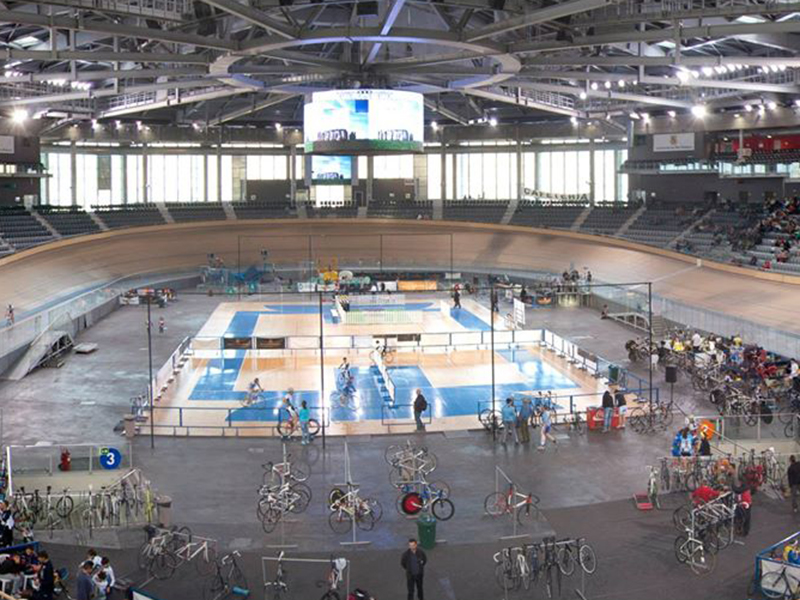
Palma Arena has always carried a slightly unusual identity in track cycling. It is modern, but not anonymous. It is clearly a major indoor venue, yet it feels shaped by place in a way many newer buildings do not. Palma de Mallorca is not just a dot on the calendar. It changes the emotional tone of the venue itself.
That matters because tracks become memorable in different ways. Some through deep history. Some through repeated championships. Some through records. Palma Arena built its reputation through speed, shape and atmosphere. It feels like a venue riders remember physically.
For another modern indoor track with a very different identity, see our feature on Saint-Quentin-en-Yvelines. Where the French national velodrome feels institutional and central, Palma feels more singular.
Palma Arena quick facts
- Official venue name: Velòdrom Illes Balears / Palma Arena
- Location: Av. de L'Uruguai s/n, 07010 Palma, Mallorca, Spain
- Track length: 250 metres
- Track width: 7 metres
- Banking: around 44 degrees on curves, 13 degrees on straights
- UCI classification: Category 1
- Indoor stands capacity for velodrome use: around 5,050
- Official venue website: Consorci Velòdrom Illes Balears
Palma Arena timeline
- 2007 - Palma Arena opens as Mallorca's major new indoor velodrome.
- Late 2000s onward - The venue establishes itself as one of Spain's key indoor track facilities.
- Today - Palma Arena remains an elite-standard track and multi-use indoor sports venue.
Why Palma mattered
Palma Arena gave Spain and Mallorca a track venue that felt immediately serious. UCI Category 1 approval matters because it places the building clearly inside the top tier of recognised indoor velodrome infrastructure. The dimensions and banking also tell you very quickly what kind of track it is.
This is not a shallow, forgiving public bowl. It is a proper steep indoor racing track. That alone gives it personality.
But the venue matters for a broader reason too. It gave the Balearic Islands a cycling venue of international seriousness rather than only a training landscape outdoors. Mallorca was already deeply associated with cycling. Palma Arena gave that wider identity an indoor track centre.
The track itself: 250 metres, 7 metres wide, and steep enough to feel memorable
Official venue details describe a 250-metre track with a constant width of 7 metres and banking of about 44 degrees in the curves and 13 degrees on the straights. Those numbers matter because they shape how the place is remembered.
A track with banking like that does not simply sit there politely. It asks something of the rider. Even before the crowd, the flags or the occasion, the geometry itself gives the building a tone.
That is one reason Palma Arena has always felt like more than a neutral indoor hall. Its characteristics are strong enough to create a sense of identity in their own right.
The venue that gave Mallorca an indoor track anchor
Mallorca hardly needed help becoming associated with cycling. But road cycling identity and track cycling identity are not the same thing. Palma Arena gave the island and the city a different sort of sporting anchor: a place where track cycling could be staged, trained and understood indoors at elite level.
That matters because sports need buildings as much as they need weather, myth and scenery. Palma Arena turned Mallorca's broader cycling reputation into something with a proper indoor velodrome centre.
What makes Palma Arena distinctive
Some venues feel defined by events. Palma Arena feels defined at least partly by the track itself. The geometry, the steepness and the sense of a serious racing bowl give it more natural character than many multi-purpose modern sports buildings manage.
That does not make it "legendary" in the same way as an Olympic track or a world championship mainstay. But it does make it memorable, and memory is often where venue identity begins.
Can readers find official Palma Arena information?
Yes. The most reliable source is the official Consorci Velòdrom Illes Balears website, which includes track specifications, contact details and wider facility information.
That is especially useful for Palma Arena because the venue operates as a broader indoor complex as well as a velodrome.
Why Palma Arena still matters
Palma Arena matters because it remains one of the clearest examples of a modern indoor track with real architectural personality. It is not only a facility. It is a venue riders can picture and describe.
In a sport increasingly full of technically competent but emotionally interchangeable buildings, that still counts for something.
Palma Arena FAQ
Where is Palma Arena?
Palma Arena is in Palma de Mallorca, at Av. de L'Uruguai s/n, 07010 Palma, Spain.
How long is the Palma Arena track?
The track is 250 metres long.
What is the banking at Palma Arena?
Official venue information describes banking of around 44 degrees on the curves and 13 degrees on the straights.
Why is Palma Arena important?
Because it is a UCI Category 1 indoor velodrome in Mallorca and one of Spain's major modern elite track venues.