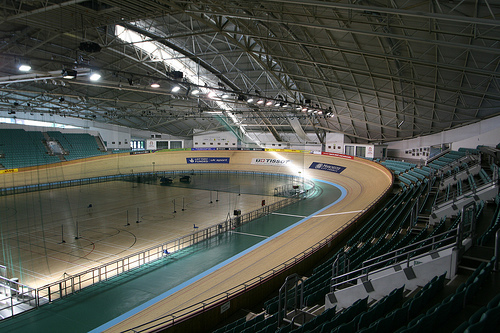
Every legendary velodrome has its own kind of authority. Some are famous because they are old. Some because they are beautiful. Some because they sit at altitude, or because the air inside them seems to reward anyone brave enough to turn the pedals hard enough. Manchester is different. Manchester matters because it became more than a venue. It became a base, a habit, a system and, eventually, a national sporting story.
For riders of a certain era, the Manchester Velodrome was not just where races happened. It was where British track cycling learned what daily elite work looked like. It was where young riders first felt the banking under them. It was where established champions kept turning up to do the unglamorous sessions that hold everything together. And it was where the sport in Britain stopped feeling occasional and started feeling organised.
That is why the building's place in cycling history is so secure. Opened in 1994, Manchester was Britain's first indoor Olympic-standard cycling track. A 250-metre Siberian pine bowl with 42.5-degree banking, it arrived with a practical purpose but grew into something far bigger: the long-term home of British Cycling and the Great Britain Cycling Team, a venue that would go on to host world championships, Commonwealth Games racing, national championships, Revolution nights and decades of daily use.
For a different kind of legendary venue, see our earlier feature on Perth Velodrome. Taken together, Perth and Manchester show that tracks do not become important in the same way. Some gain prestige through rarity, others through consequence.
Manchester Velodrome quick facts
- Official venue name: National Cycling Centre Manchester
- Opened: 1994
- Track length: 250 metres
- Banking: 42.5 degrees
- Track surface: Siberian pine
- Home of: British Cycling and the Great Britain Cycling Team
- Major events: UCI Track World Championships in 1996, 2000 and 2008; 2002 Commonwealth Games; repeated national championships; Revolution series
- Official venue website: National Cycling Centre
Manchester Velodrome timeline
- 1994 - Manchester Velodrome opens as Britain's first indoor Olympic-standard track.
- 1996 - UCI Track World Championships arrive in Manchester.
- 2000 - The World Championships return.
- 2002 - The Commonwealth Games bring the venue into a wider British sporting story.
- 2008 - Manchester hosts the Track World Championships again.
- Today - The building remains central to the identity of the National Cycling Centre and British track cycling.
Manchester Velodrome history: why 1994 mattered so much
It is easy, with hindsight, to treat Manchester as inevitable. British Cycling has become so closely associated with the building that it can feel as though the two were always destined to belong together. They were not. The real significance of Manchester is that it gave British cycling permanence at a moment when permanence mattered.
Before a programme can dominate, it needs somewhere to keep showing up. Not once a year. Not only when a championship is in town. Every week. Every month. Every winter. Manchester gave British riders a proper indoor home and, in doing so, changed the emotional geography of the sport in Britain. Training was no longer scattered. Knowledge was no longer so dependent on chance. Talent did not have to imagine elite track cycling from a distance. It could see it, hear it, ride near it and, if good enough, grow inside it.
That is part of what makes the velodrome so important in the story of British sport more broadly. This was not just a fast track built for the sake of spectacle. It was infrastructure. It was a statement that track cycling in Britain should not survive only through enthusiasm and improvisation. It should have a proper home.
Once you understand that, the later results make more sense. Medals still required riders, coaches, funding, pressure and immense sacrifice. But buildings matter. Daily environment matters. Familiarity matters. Manchester did not win races on its own, but it helped create the conditions in which winning stopped looking impossible.
National Cycling Centre Manchester: more than a velodrome
One reason this building ranks so highly in the sport's memory is that it was never only a velodrome. The Manchester track sits within the wider National Cycling Centre, and that changed what the building could mean. It was not simply a site for championships. It became a place of routine, structure and visibility.
The phrase "home of British Cycling" can sound like branding unless you stop and think about what it really means. A national home is where the sport learns how to behave every day. It is where pathways become visible. It is where juniors see seniors, where standards become normal, where coaching ideas are tested and where excellence stops feeling theoretical.
That broader institutional story also sits behind our feature From Medals to Meaning: British Cycling 2006 to 2026. Manchester did not create that whole story on its own, but it gave it walls, timber and repetition.
The track itself: 250 metres, 42.5-degree banking, and a feel all of its own
On paper, Manchester's technical details are straightforward enough. The track is 250 metres long. The banking reaches 42.5 degrees. The timber is Siberian pine. But tracks are never only numbers. Riders remember feel. They remember the first lap up on the banking and the way the wood seems to rise at them more aggressively than it did from the infield. They remember the sound of training wheels on a quiet weekday session. They remember how different a full house feels from a near-empty hall.
A velodrome becomes legendary not only through engineering, but through repetition. The same corners. The same black line. The same long accumulation of nerves, confidence, mistakes and breakthroughs. Manchester has that kind of memory in its fabric. It has seen first introductions and final rehearsals. It has seen juniors learning to hold their line and Olympic champions doing another effort because the schedule said one more.
That duality is part of its identity. On one day Manchester Velodrome is a national stage. On another, the National Cycling Centre feels like a working room. That is part of what gives the place its authority.
The track that built a system
Elite sport is rarely transformed by one grand idea alone. It is transformed by accumulation. The same coaches in the same environment. The same standards repeated until they become culture. The same rider pathways being refined year after year. The same building teaching people what serious preparation actually looks like.
Manchester became the place where all of those layers could sit on top of one another. It offered visibility as much as convenience. Young riders could look at the track and understand that this was where the sport lived. Established riders could train in an environment built for the job. Staff could work in a place where the track was not a distant symbol but a daily reality.
That is why Manchester's legacy is much larger than the list of medals associated with it. It helped Britain move from isolated excellence to structural excellence. A great rider is still a great rider. But Manchester made it easier for great riders to emerge, be recognised, be developed and stay connected to a national programme that believed it had the right to aim high.
The defining events that made Manchester Velodrome legendary
World Championships on repeat
Few venues build authority more quickly than those trusted repeatedly by the sport at its highest level. Manchester hosted the UCI Track World Championships in 1996, 2000 and 2008, giving the building a rare sense of recurrence on the world stage. It was not a novelty stop. It was somewhere the sport kept coming back to.
That repetition matters. A one-off championship can be memorable. Three world championships begin to shape identity. They tell riders, fans and administrators that this is not simply a competent venue. It is a venue that belongs in the conversation whenever track cycling's biggest events are being discussed.
The 2002 Commonwealth Games
If the world championships confirmed Manchester's international credibility, the 2002 Commonwealth Games helped embed it in Britain's wider sporting memory. Multi-sport events always change how a venue is seen. They open it up to audiences who might not otherwise have followed track cycling closely, and they make the building feel woven into the life of the host city rather than tucked away as a specialist space.
For Manchester, that mattered. The velodrome was no longer just a serious place for serious cyclists. It became part of a bigger civic story about sporting ambition, regeneration and identity.
Revolution nights
Ask enough British track cyclists what Manchester meant to them and, sooner or later, the conversation drifts towards Revolution. Long before every race could be clipped, packaged and pushed through the algorithm, Revolution gave British track cycling a live theatre of its own. It brought stars close enough to hear, gave domestic crowds something regular to anticipate, and let riders occupy that unusual space between hard competition and showmanship.
That should not be dismissed as nostalgia. Revolution helped make the sport feel culturally alive. It gave Manchester personality as well as prestige. It reminded everyone that a velodrome should not only produce champions. It should also produce attachment.
The riders who gave the building its human weight
No great venue is legendary on architecture alone. It becomes legendary because riders leave part of themselves there. Manchester's story is therefore inseparable from the generations who trained, raced, won and lost inside it.
Chris Boardman belongs to the early mythology of modern British track cycling and to the broader shift in how Britain imagined itself in high-performance cycling. Chris Hoy and Victoria Pendleton belong to the era in which Manchester became shorthand for excellence. Jason Kenny belongs to the years when medal success began to feel almost habitual. Then came the team pursuit generations, the endurance squads, the sprinters, the para-cycling stars, and the riders who never became household names but still shaped the standards around them.
That is one of the building's quieter truths. A national home is never only about the stars whose names live in the headlines. It is also about the training partners, the nearly-riders, the riders who spent three winters in the system and left, the riders who returned as coaches, the riders who discovered how high the level really was and what it would take even to stay close to it. Legendary venues hold all of those lives at once.
Can the public ride Manchester Velodrome?
Manchester is one of those rare famous venues that still feels practically useful rather than purely historical. The National Cycling Centre Manchester is not only a symbol of the sport. It is also the official public-facing home of the venue.
For current access, beginner information, venue contact details and any up-to-date session information, the best place to start is the official National Cycling Centre website. That keeps the page useful for readers who arrive here through search not only for history, but because they want to understand how the venue fits into track cycling now.
That public-facing link matters. It gives Manchester something many famous velodromes lose over time: everyday relevance. It is not simply remembered. It is still part of the lived shape of British track cycling.
Why Manchester Velodrome still matters today
A legendary venue can become trapped by its own history. Manchester has largely avoided that. The building's importance is not only retrospective. It still sits at the centre of British track cycling's memory, language and identity rather than existing only as a monument to a finished era.
That matters because sporting heritage is most powerful when it remains active in people's minds. There is a big difference between a famous building and a meaningful one. Manchester is both. Riders still talk about it as a place that shaped careers. Fans still treat it as a proper stage. And the National Cycling Centre remains the official reference point for anyone trying to understand the venue beyond nostalgia.
And perhaps that is the real reason Manchester deserves a place in any series on the world's legendary velodromes. Not because it is the oldest. Not because it is the rarest. Not because it sits in some romantic isolation. But because it changed what was possible for a country that needed somewhere to begin acting like a serious track nation.
Legend, in Manchester's case, is not built only on atmosphere. It is built on repetition, utility and consequence. The track did not merely witness British cycling's rise. It helped make that rise durable.
Manchester Velodrome FAQ
When did Manchester Velodrome open?
Manchester Velodrome opened in 1994.
How long is the track at Manchester Velodrome?
The track is 250 metres long.
What is the banking at Manchester Velodrome?
The banking is 42.5 degrees.
What is the official venue name?
The wider venue is generally referred to as the National Cycling Centre Manchester.
Why is Manchester Velodrome so important in British cycling history?
Because it became the long-term home of British Cycling and the Great Britain Cycling Team, giving the sport in Britain a permanent elite base rather than an occasional venue.
What major events has Manchester Velodrome hosted?
Its best-known events include the UCI Track World Championships in 1996, 2000 and 2008, the 2002 Commonwealth Games, repeated national championships and the Revolution series.