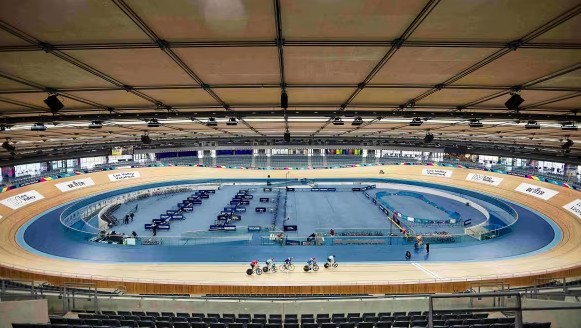
The velodrome at Lee Valley VeloPark has a particular place in modern track cycling because it managed to avoid the fate that shadows so many Olympic venues. It was not built simply to impress the world for a fortnight and then become a monument to a past promise. Instead, it remained part of the sport's active life.
That matters because velodromes become important in different ways. Some become legendary through age. Some through atmosphere. Some because records and riders keep returning to them for years. London became important because it combined global visibility with public usefulness. It was an Olympic stage, a world championship venue and a track ordinary riders could still hope to experience.
That combination is rarer than it should be. It is also why the London velodrome deserves a serious place in any modern venue series.
For a different kind of enduring indoor track, see our feature on Manchester Velodrome. Where Manchester helped build a national high-performance identity over decades, London became something else: a spectacular modern landmark that stayed relevant after the spotlight moved on.
London Velodrome quick facts
- Official venue name: Lee Valley VeloPark
- Location: Abercrombie Road, Queen Elizabeth Olympic Park, London E20 3AB
- Track length: 250 metres
- Track surface: Siberian pine
- Significance: London 2012 Olympic track cycling venue
- Part of wider complex: velodrome, BMX track, road circuit and mountain bike trails
- Major events: London 2012 Olympic Games; 2016 UCI Track Cycling World Championships
- Official venue website: Lee Valley VeloPark
London Velodrome timeline
- 2011 - The velodrome building is completed as part of the London 2012 Olympic Park project.
- 2012 - London hosts the Olympic track cycling competition.
- 2014 - Lee Valley VeloPark opens to the public as a broader cycling centre.
- 2016 - The UCI Track Cycling World Championships are held in London at Lee Valley VeloPark.
- Today - The venue remains active for public riding, club use and elite cycling.
Why London mattered differently
A lot of famous velodromes become famous slowly. The London velodrome did not have that luxury. From the start, it was going to be seen. It was being built for the Olympics, in a city that understood presentation, on a site that would be watched and discussed at global scale.
That can be a burden as much as an opportunity. An Olympic venue enters the sport carrying expectation before it has earned memory. Everyone already knows it, but not yet for the right reasons. The real question comes later: what remains once the opening story has faded?
In London's case, quite a lot remained. The building did not only survive. It settled into the sport. That is what makes it more than an Olympic relic.
The track itself: 250 metres, Siberian pine, and built for speed
Official venue material describes the indoor track as a 250-metre Siberian pine velodrome, and that alone places it firmly inside the language of elite modern track cycling. It was built to be fast, clean and visually distinctive, but also to sit within a venue intended to welcome people beyond the highest level of the sport.
That matters because the building has always had two identities at once. It is unmistakably an elite venue. But it is also part of a wider public cycling complex. That dual role shaped how the London velodrome has aged. It did not freeze in elite memory only. It kept meeting everyday users.
That is one reason it still feels alive. Tracks remain culturally important when riders continue to encounter them directly, not just through archive footage.
The Olympic venue that avoided becoming a museum piece
The most admirable thing about the London velodrome may be the simplest. It stayed in use. That should not be exceptional, but in sport it often is.
Olympic architecture is full of buildings that were once loaded with meaning and then slowly emptied of it. Lee Valley VeloPark moved in another direction. Because the wider site includes all four Olympic cycling disciplines and because the venue kept opening itself to public sessions, it avoided becoming a symbol without a function.
That is not just good operations. It changes the venue's place in the sport. It means London is remembered not only as the site of triumph and spectacle, but as a track people can still ride.
The event that made London unforgettable first
London 2012
The first layer of London's meaning is obvious. The 2012 Olympic Games placed the velodrome instantly at the centre of world cycling attention. Olympic track racing does that to a building. It compresses emotion, national pressure, noise and memory into a few days, then leaves the venue carrying those associations for years.
For British cycling in particular, the Olympic story gave the velodrome extraordinary emotional force. It became associated with home success, crowd intensity and the feeling that track cycling in Britain had found a stage worthy of its status.
That was the beginning of the building's legend. But it was not the whole story.
2016 Track World Championships
The 2016 UCI Track Cycling World Championships gave London a second major layer of significance. This time the venue was not simply replaying Olympic memory. It was proving it could stand as an elite world championship site in its own right.
That mattered because repeat relevance always matters. One huge event can make a building famous. A second serious event helps make it credible. The worlds in London confirmed that Lee Valley VeloPark was not merely riding Olympic afterglow.
The riders who gave London its emotional weight
No velodrome becomes meaningful through design alone. Riders give it voice. Crowds give it atmosphere. Together they turn a venue from infrastructure into memory.
In London's case, that emotional weight comes from a dense concentration of British track cycling history. The names associated with the venue are inseparable from the wider London 2012 story and from the years around it. That gives the building a particular charge in British sporting memory, even for people who are not daily track followers.
But the venue's emotional value is not limited to household names. It also comes from the thousands of riders who have entered it after the Olympic moment, whether through club sessions, introductory experiences or more serious training. Those riders do not create headlines, but they do create continuity.
Can the public ride the London Velodrome?
Yes, and that is one of the venue's greatest strengths. Lee Valley VeloPark explicitly offers track riding from beginner experience sessions through to more advanced use. Official venue pages make clear that the velodrome is not reserved only for elite riders.
That keeps the building honest in a way some major venues never quite manage. It remains aspirational, but it is not fully sealed off. You can still approach it as a rider, not only as a spectator or historian.
For current session details, access information and venue contact routes, the best place to start is the official Lee Valley VeloPark track cycling page.
Why London still matters
Some venues are important because they built systems. Some because they host relentlessly. Some because they are beautiful enough to become shorthand for the sport itself. London's velodrome matters because it managed to be globally recognisable and still practically useful.
That is no small achievement. It means the building remains part of track cycling's live culture rather than just its archive. People still know where it is, still ride it, still visit it and still place major memories inside it.
That is why London's velodrome deserves to be treated seriously. Not just as an Olympic building, and not just as a piece of design, but as one of the modern tracks that proved visibility and long-term relevance do not have to cancel each other out.
London Velodrome FAQ
Where is the London Velodrome?
The velodrome is at Lee Valley VeloPark, Abercrombie Road, Queen Elizabeth Olympic Park, London E20 3AB.
How long is the track at the London Velodrome?
The indoor track is 250 metres long.
Why is the London Velodrome important?
Because it was a London 2012 Olympic venue, later hosted the 2016 UCI Track Cycling World Championships, and remains a major public and elite cycling venue.
What major events has the London Velodrome hosted?
Its best-known major events include the London 2012 Olympic track cycling competition and the 2016 UCI Track Cycling World Championships.
Can the public ride the London Velodrome?
Yes. Lee Valley VeloPark offers track riding for beginners through to experienced riders.
Where should I go for official venue details?
Use the official Lee Valley VeloPark site or the track cycling page.