San Cristobal, 1977, was the moment the sport had to stop being polite about Japan. Nakano won the professional sprint title there in an all-Japanese final against Yoshikazu Sugata, with the defending champion John Nicholson left in bronze. That was not a charming upset or a nice international story. It was a transfer of power. The most prestigious sprint title in track cycling had found a new owner, and even on the day of its capture the podium made clear that this was larger than one gifted rider. Japan had not produced an outsider who happened to win. It had produced the strongest professional sprinter in the world.
What followed still looks faintly unreal when laid out in sequence. Munich. Amsterdam. Besancon. Brno. Leicester. Zurich. Barcelona. Bassano del Grappa. Colorado Springs. Different tracks, different climates, different challengers, same ending. Nakano won 10 consecutive world titles in the professional sprint from 1977 to 1986, a run that remains unmatched in the event. The point is not only the number, though the number is absurd enough. It is the burden inside it. A title is hard to win once. To carry it from country to country for 10 years, while every serious sprinter in the field studies you and comes looking for the weak point, is a different order of achievement.
That is why his reign still feels so severe. It was not built against one static field. The names changed because the sport changed. Dieter Berkmann came after him and lost. Gordon Singleton came after him and lost. Yave Cahard came after him and lost. Ottavio Dazzan came after him and lost. Nakano kept staying the best while the sport renewed itself around him.
The rivalry with Gordon Singleton gives the streak some of its hardest edges. By the early 1980s Singleton had become one of the great sprinters in the world, and in Brno in 1981 and Leicester in 1982 he finished second to Nakano. Leicester, especially, never settled into clean history. The final ended in a crash, Singleton broke his collarbone, and Nakano left with a sixth consecutive world title. The record books move on from moments like that with brutal efficiency. Rivals rarely do. Great dynasties leave more than defeat. They leave irritation, unfinished arguments, the sense that the door should have opened and did not.
1977 - San Cristobal
1978 - Munich
1979 - Amsterdam
1980 - Besancon
1981 - Brno
1982 - Leicester
1983 - Zurich
1984 - Barcelona
1985 - Bassano del Grappa
1986 - Colorado Springs
Yet this is exactly why Nakano's greatness has to be understood in full. He kept putting himself in positions where these arguments could even exist. Match sprinting does not reward speed alone, and long sprint dynasties are never explained by power in isolation. They are built on judgement, composure and the ability to control the emotional temperature of a race before the final acceleration begins. The greatest sprinters do not just go faster; they reduce the options around everyone else. They make opponents race in reaction rather than conviction. Nakano rode with that kind of authority. By the end of the streak, he was being described not as a man surviving chaos but as a champion winning with mastery.
There is a revealing honesty in the way he later spoke about the burden of dominance. "Pressure wouldn't disappear as long as I had a desire to win." That strips the romance out of the record and shows the human cost of carrying it. Ten straight world titles can look serene from a distance. They were nothing of the sort. Every successful defence multiplies expectation. Every year extends the shadow. Every title makes the next one heavier because the rider is no longer chasing something clean and open. He is defending his own past. Nakano's achievement was not simply that he could win the sprint. It was that he could continue to want the pressure that came with remaining the champion.
This is where the Japanese context stops being background and becomes the heart of the story. Too much writing from outside Japan has treated keirin as atmosphere: colourful, intriguing, slightly mysterious, but somehow secondary to the main business of international track cycling. In truth, keirin was central to the making of Nakano. Post-war Japanese keirin was already a fully formed professional environment with its own discipline, prestige and seriousness. It had been publicly organised since 1948, with revenues directed into the public good. It was not a decorative side-story to the sport. It was a deep racing culture that trained judgement as hard as it trained speed.
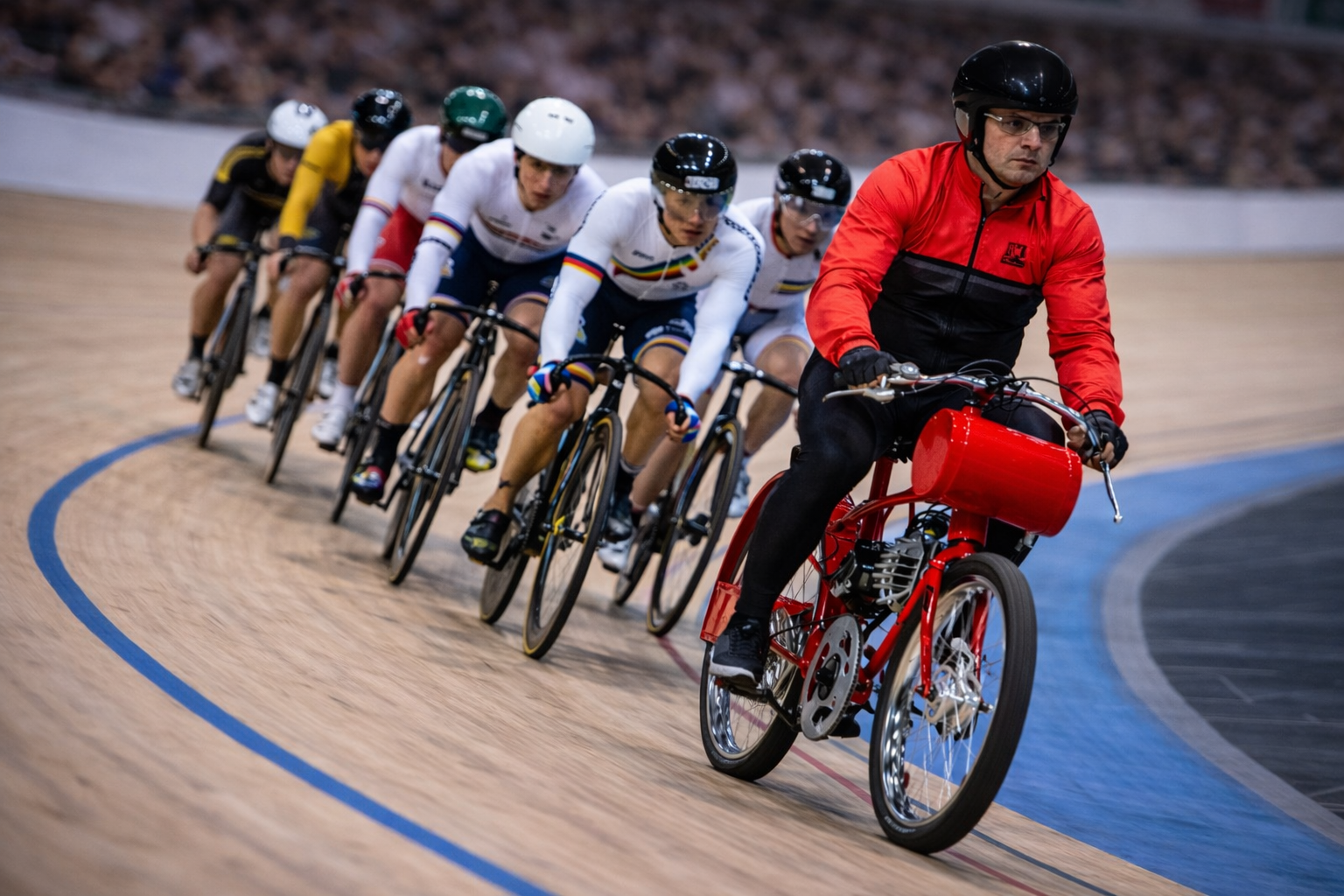
That world shaped the rider. Keirin demanded nerve, timing, positioning, patience and release. It required speed to be applied with intelligence rather than merely displayed. Nakano later put the cultural gap plainly: "The style of competition like keirin was nonexistent in Europe." That was not a boast. It was an explanation. Europe understood track cycling through its own traditions, and for a long time it did not fully understand what Japan had built. Nakano's world titles forced that recognition. Year after year, the sport's most prestigious sprint crown was being carried away by a man formed inside Japanese keirin.
Nakano's 10-title run came in the professional sprint, in the era when the UCI World Championships still separated amateur and professional events. Those categories were merged into a single open championship in 1993. That does not reduce the achievement. It defines it precisely: Nakano ruled the professional world sprint for a decade.
It also mattered that he did not emerge alone. Australian sprint coach Bill Long worked in Japan in the 1970s, and the significance of that period is clear enough: Japanese professionals won 14 World Championship medals between 1975 and 1986, including Nakano's 10 golds. This is not a story about imported expertise creating excellence from nothing. It is the opposite. It is evidence of a racing culture strong enough to absorb outside knowledge and turn it into something lasting. Nakano was the sharpest expression of that culture, not its lone exception.
By the time the streak reached Colorado Springs in 1986, the symbolism had become almost too neat. Nakano won his 10th consecutive world sprint title there, and the podium behind him was entirely Japanese: Hideyuki Matsui second, Nobuyuki Tawara third. Ten years earlier San Cristobal had announced that a Japanese rider could own the title. Colorado Springs showed something larger: Japanese sprinting was not a one-man interruption in the history of the event, but a genuine power within it. The emperor was still there, but now the kingdom behind him was visible as well.
That is why he still feels present now. Modern sprinting has produced champions of extraordinary force, and any rider who stacks enough rainbow jerseys eventually finds Nakano waiting in the comparison. But his importance is larger than record-book comparison. He matters because he changed the map. He made international track cycling confront a truth it had not fully absorbed: a Japanese rider, shaped by Japanese keirin, could define the highest standard in the sport's most prestigious sprint event for longer than anyone else before or since.
So the making of a sprint emperor was neither mystical nor accidental. It was the meeting point of one rider's appetite for control and one nation's deep professional racing culture. Nakano supplied the calm, the nerve, the repeated execution and the willingness to carry pressure until it became part of his identity. Japan supplied the unforgiving environment that taught a sprinter how to read speed, risk and opportunity with professional clarity. Put those things together and the result was not merely a champion. It was a reign.
And that is the right way to remember Koichi Nakano. Not as a historical curiosity. Not as a prelude to somebody else's modern greatness. But as one of the men who set the terms of sprint supremacy itself. For 10 years, the world title belonged to him. More importantly, for 10 years the rest of track cycling had to live with a fact it was slow to understand: the centre of sprinting was not where it assumed.