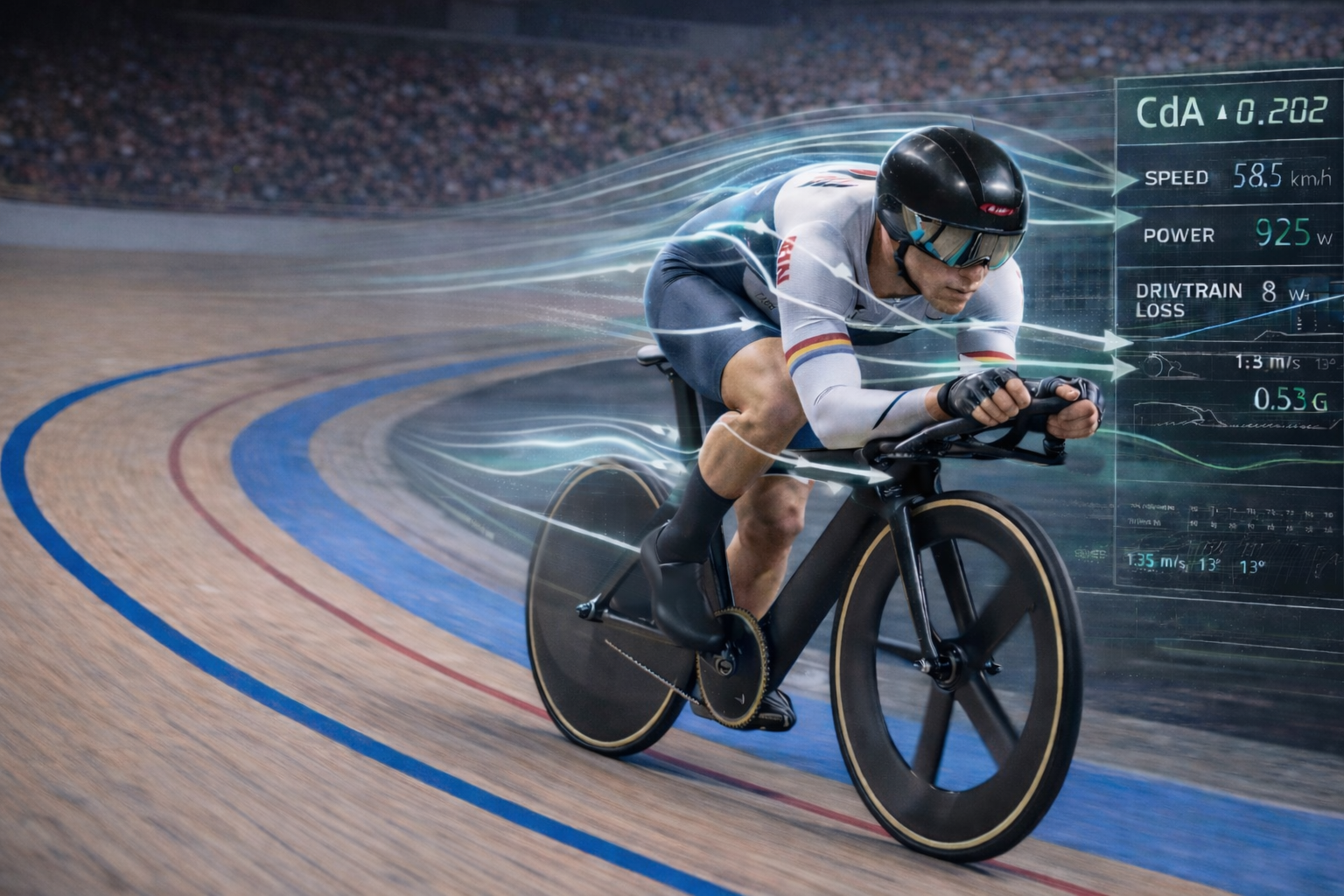
There is a moment in every standing start where the bike stops feeling like a bike and starts feeling like a locked gate. The gear is heavy, the cadence is low, and the rider is trying to turn force into speed without losing timing.
At elite level, that moment is rarely limited by effort. It is limited by mechanics: how torque is created at the hip and knee, when it appears relative to crank angle, and how cleanly it is transferred through the pedal.
That is why joint kinetics - the analysis of joint torques and power at the hip, knee and ankle - is so useful. It moves us beyond "more watts" and into "where are the watts coming from, and where are they leaking?".
Why joint kinetics matters
Peak power is an output. Joint kinetics is a mechanism. In practice, the difference is this: two sprinters can produce similar peak watts on paper, but arrive at those numbers via different joint strategies.
If your sprint programme has not changed in five years but your peak power has plateaued, the limiter may not be strength. It may be mechanics
One rider can be hip-dominant with smooth crank torque. Another can lean harder on knee extension with a sharper torque peak and a more pronounced dead spot.
The ECU doctoral thesis Assessment of Joint Kinetics in Elite Sprint Cyclists by Cycling Australia Performance Specialist Dr Lynne Munro, is valuable because it is built around highly trained sprint cyclists rather than generic participants. It also sits in an applied Australian sprint context, acknowledging involvement from the Cycling Australia environment - including former Australian sprint coach Nick Flyger - alongside ACT-based sprint athletes and staff.
Effective torque, delivered at the right crank angle, is.
Hip vs knee: two sprint power profiles
A useful way to think about joint kinetics is not to chase a single "ideal" technique, but to recognise that riders often develop a dominant pattern - a joint contribution signature. The thesis supports the view that hip contribution is typically a major driver in maximal sprint cycling, but that knee contribution and timing can separate riders with similar headline power.
Hip-dominant profile
- Strong hip extension contribution through early-to-mid downstroke
- Smoother crank torque with fewer obvious dead spots
- Often resilient at low cadence, high torque (standing starts)
- Can tolerate heavier gear inches if timing is stable
Knee-dominant profile
- More pronounced knee extension peak around mid downstroke
- Higher risk of sharp torque peaks and deeper troughs if timing drifts
- Can look explosive when fresh, but may be more fatigue-sensitive
- Often benefits from cadence development and technical smoothing work
The point is not that one profile always wins. The point is that training, equipment and race demands will interact with the profile you have. A team sprint starter needs brutal early torque and repeatable delivery. A flying 200 specialist needs stability at extreme cadence. Some riders can do both. Many are biased one way.
Standing starts: torque, timing, and the first 3 revolutions
Standing starts are where joint kinetics becomes immediately practical. The first few pedal revolutions are torque-dominant. Cadence is low. The bike is slow. Every tiny delay in joint sequencing is magnified because the system has no momentum to hide it.
Applied interpretation of joint kinetics suggests three things matter in those first revolutions:
- Hip torque timing: the hip needs to deliver meaningful extension torque when the crank has mechanical advantage, not early when it is still "behind the gate".
- Hip-knee handover: the transition from hip-driven torque to knee-driven support should be smooth, not a gap that creates a trough in crank torque.
- Foot stability: ankle strategy should support force transmission rather than introducing wobble or lost stiffness through the shoe-pedal interface.
This is where coaching language often fails. "Push harder" is not a cue. "Hit the gate cleanly" is closer, because it implies timing. A more modern question is: does the rider's strongest torque coincide with the crank's best leverage?
Practical drill (rider)
Film 3 standing starts from side-on. Count the first 3 full revolutions. Look for:
- Trunk movement that collapses hip angle before the first acceleration is complete
- Any visible pause or "stall" at the top of the stroke
- Whether cadence rises smoothly or in steps
If cadence rises in steps, you may be producing torque in bursts rather than continuously - a coordination problem, not a motivation problem.
Flying 200: cadence stability and neuromechanical precision
The flying 200 sits at the opposite end of the mechanical spectrum. Cadence is high. Angular velocity is huge. The time window to apply effective force is tiny. At that point, raw strength is less limiting than timing stability.
The ECU thesis matters here because joint kinetics thinking implies that sprint performance at extreme cadence is partially a motor control problem. At 150+ rpm, small sequencing errors amplify:
- Torque peaks become sharper
- Torque troughs deepen
- Dead spots become more costly
- Upper-body stability becomes harder to maintain
This is a useful lens for why some riders with world-class gym numbers struggle to translate to flying 200 speed: the coordination pattern does not hold at high angular velocity.
Tournament repeatability: technique drift before power drops
One of the most valuable applied takeaways from sprint biomechanics is that fatigue can show up as a mechanical drift before it shows up as a headline power drop.
In match sprint and keirin tournaments, riders repeatedly hit near-maximal outputs. Between rounds, the conversation is often metabolic: phosphocreatine resynthesis, hydration, carbohydrate, relaxation.
But joint kinetics analysis encourages an additional question: is the rider's torque delivery pattern changing between rounds? If knee contribution becomes delayed, if hip torque becomes early, if trunk stability collapses, the rider can still produce big watts while being slower in the first 30 metres of the sprint.
Practical drill (coach)
Pick one repeatability session (e.g., 4-6 x 10-12 seconds from rolling speed). Capture a short clip of the final two reps. Compare them to rep 1:
- Is hip drive still present, or has the rider started to "knee punch" the stroke?
- Does cadence rise at the same rate, or does it plateau earlier?
- Is upper-body stability visibly reduced?
If mechanics degrade while peak power stays high, your limiter is coordination under fatigue, not strength.
Equipment as a constraint: crank length, hip angle, and trade-offs
Equipment is not neutral. Joint kinetics makes that unavoidable.
Crank length changes joint range of motion and torque demand. Saddle height changes hip extension and knee angle. Bar drop changes trunk angle and effective hip flexion. Each of these can shift the joint contribution balance.
For sprint riders, this creates a trade-off triangle:
- Hip angle (power expression and comfort under torque)
- Aero posture (speed for a given power)
- Cadence ceiling (how well timing holds at high rpm)
Many riders chase aerodynamics so aggressively that they compromise hip extension capacity. Joint kinetics thinking suggests the fastest position is not the lowest position. It is the position that preserves effective hip contribution while still being aerodynamically credible.
How to use this as a rider or coach
If you want to apply this research without a biomechanics lab, focus on mechanical proxies you can actually measure:
- Cadence rise profile in starts: smooth rise suggests stable sequencing; stepped rise suggests force bursts and timing gaps.
- Repeatability under fatigue: compare rep 1 vs rep 5 technique, not just watts.
- Gear inches realism: if you "need" a massive gear to feel fast but it delays cadence rise, you may be masking a timing issue with load.
- Video stability: trunk collapse is often a hip-angle problem before it is a conditioning problem.
Rider action plan (one week)
- Day 1: 3 x standing starts filmed side-on (first 3 revolutions focus)
- Day 3: 4 x 10-second high-cadence efforts (film rep 4)
- Day 5: 5 x 12-second repeatability session (compare rep 1 vs rep 5 mechanics)
Goal: identify whether your limiter is torque capacity, timing stability, or fatigue-induced drift.
What this cannot tell us
Even applied, elite biomechanics research has limits. Joint kinetics is typically derived from controlled laboratory or ergometer conditions. The velodrome adds banking forces, tactical pacing, positional stress, and psychological load. Joint kinetics will not tell you who will win a keirin final.
But it can tell you why two riders with similar peak power might accelerate differently, why some riders lose repeatability across rounds, and why certain position changes feel fast in a wind tunnel but slow in a sprint.
That is the value: not a single answer, but a sharper set of questions.