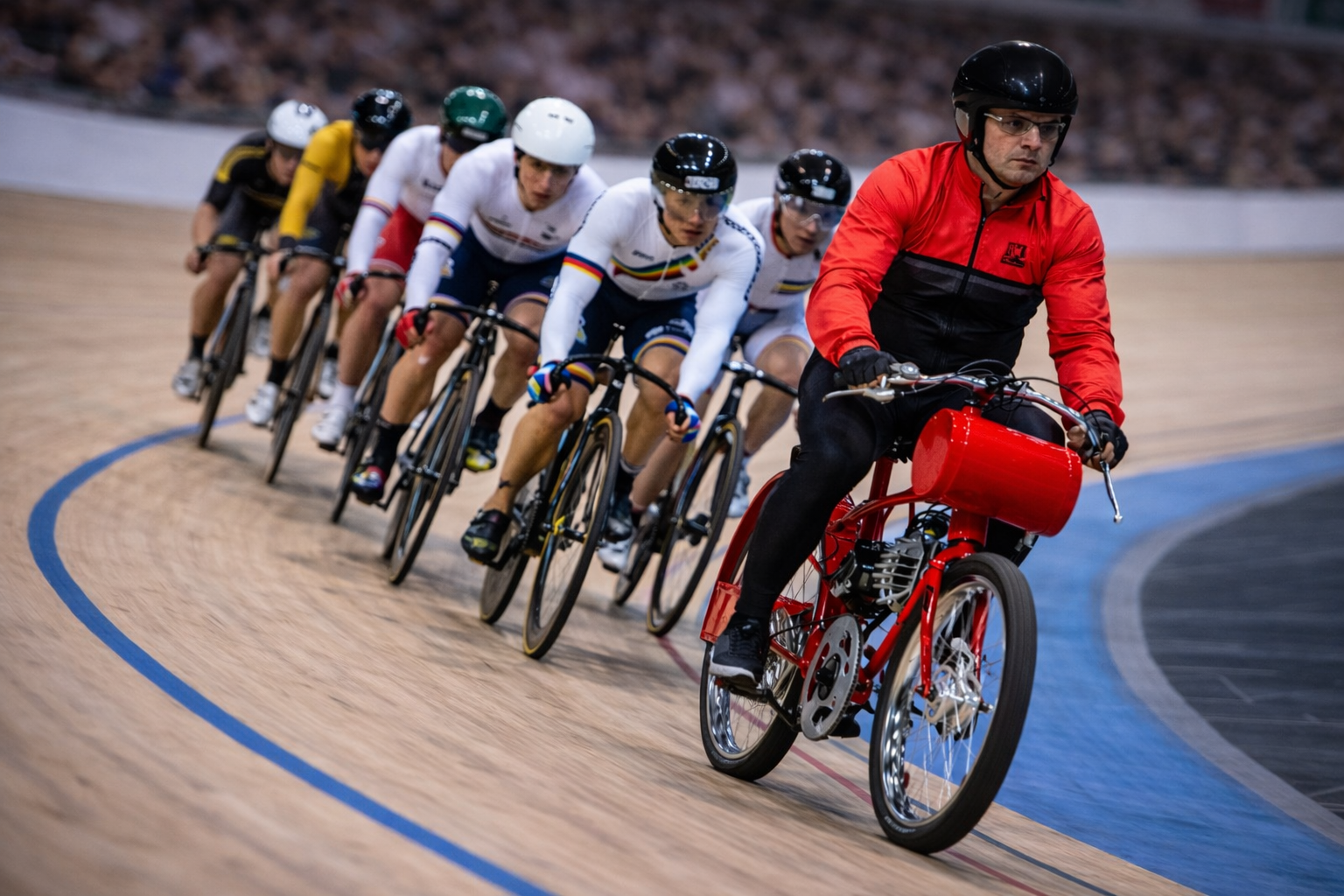
Most track fans think they know keirin. They know the outline of it, certainly. A paced opening. A field held in check. Then the release: speed, noise and a final rush to the line. It is one of the easiest events in track cycling to recognise and one of the easiest to reduce to its surface.
Because the keirin most of the world watches at the Olympics or World Championships is not Japanese keirin preserved in its original form. It is the exported version: a race format lifted from a much larger domestic sport and made legible to an international audience. The name travelled. The broad shape travelled. Much of the deeper structure did not.
What emerged in Japan in 1948 was not simply a race that would later find its way into the Olympic programme. It was a year-round sport with its own hierarchy, its own tactical language, its own rider classifications, its own school, its own audience and its own place in public life. It developed into a public institution as well as a sporting one, with revenues directed into wider social use. Olympic keirin is an event. Japanese keirin is a system.
The distinction changes how the race is read. Outside Japan, keirin is usually consumed as spectacle. Inside Japan, it is also read as pattern, role, character and intent. The sprint still matters, of course it does, but it sits inside a much denser framework than most international viewers ever see.
Olympic keirin borrowed the shape of the race. Japanese keirin kept the whole world around it: the lines, the rider types, the rankings, the race card, the school, the signals and the domestic logic that make the event readable long before the finish.
Not just a race, but a ladder
One of the clearest differences is scale. In international track cycling, keirin appears as part of a championship programme. In Japan, it lives as a sport in its own right. The domestic season runs through the year and rises towards the Keirin Grand Prix at the end of December. Beneath that summit sits a full event structure, from major meetings down through lower levels, and beneath that again sits the rider ranking system that shapes careers from one half of the year to the next.
It gives the sport memory. Riders are not simply turning up for one isolated keirin race in a championship setting. They are moving through a ladder. Rank can rise. Rank can fall. Reputation is not just built on one night of brilliance but on repeated performance, tactical reliability and the ability to survive inside the domestic order over time.
Japanese keirin is not just a start list. It is a career structure.
- A year-round calendar rather than a handful of championship appearances
- A formal event hierarchy rather than one flat event format
- Rider rankings that rise and fall with performance
- A sport followed through form, status and tactical pattern, not just final results
The line is not a detail. It is the language.
This is the point most outside readers miss first. In Japanese keirin, the line is not just a visual arrangement before the race gets serious. It is the tactical unit through which the race is understood.
Riders form in single file not only to save space or settle the track, but to shape the race itself. A line makes overtaking harder. It gives riders roles. It creates order inside apparent disorder. The rider at the front is not the whole story. The rider behind may be protecting, delaying, blocking, preparing to switch, or buying time for something later. Even before the sprint begins, the race already has structure.
Once you see that, Japanese keirin stops looking like controlled chaos and starts looking like organised intent.
The second rider matters far more than many outside readers realise. In the Olympic version, casual viewers often read the race as though only the rider at the front or the rider launching the winning move really counts. In the Japanese domestic version, the rider behind may be shaping the race just as much: guarding the line, blocking a rival, widening the gap, or preserving the conditions for a later move. The line is not background. The line is the race taking shape.
A rider sitting second wheel is not merely waiting. They may be protecting the leader, blocking a move, buying time for the line, or preparing for their own moment later. That is one of the biggest differences between reading Japanese keirin and simply watching a late sprint unfold.
Senko, makuri and oikomi
This is where the sport's tactical language becomes essential.
Senko, makuri and oikomi are not decorative bits of Japanese terminology dropped into commentary for colour. They describe three different ways of riding a race, and three different ways of answering the question of when a rider wants to make themselves visible.
Senko is the long move from the front. It is forceful, committed and often exposed. The rider goes early, takes responsibility for the race and tries to make everyone else come through them. It is a style that can look brave, aggressive and brutally honest, but it also leaves the rider open for longer.
Makuri is different. It is the sweeping move from behind, later and often more abrupt, launched once the race has opened and the timing feels right. Where senko declares itself, makuri arrives at speed. It often carries a sense of momentum and precision rather than prolonged exposure.
Oikomi is later still. It is the delayed finish, held back until the last moment, often from deeper in the line. It depends on patience, judgement and a race unfolding in a way that leaves one final gap to attack. Done well, it can make a rider look as though they have appeared from nowhere, even though the whole race has been building towards that moment.
These are not merely styles. They are part of the way the race is read. A rider is not only strong or weak, quick or slow. A rider may be a senko rider, a makuri rider, an oikomi rider, or someone capable of more than one of those shapes depending on the day and the line around them.
It is far removed from the simplified international idea of keirin as a paced opening followed by a sprint.
- Senko: the long front-running move, often launched early and ridden with commitment.
- Makuri: the later sweeping attack from behind, usually once the race begins to open.
- Oikomi: the delayed late finish, often held until the final metres.
These are not just labels. They are part of the tactical grammar of Japanese keirin.
The race is read before it is won
The grammar extends beyond the line itself. Japanese keirin teaches its audience to read the race before the sprint decides it.
The race card is part of that. It does not treat a rider as a blank name beside a start number. It builds a portrait. Registration area. Current rank. Previous rank. Age. School term. Rider characteristic. Race score. Winning techniques. Counts that show how often a rider tends to lead at key moments. Recent results. This is a sport that expects its audience to notice pattern.
The question is not simply who is in the field. It is what kind of rider they are, how they usually race, whether they tend to go early, come late, protect well, hesitate, commit or change rhythm under pressure.
In that sense, Japanese keirin asks more of its audience than the Olympic event usually does. It is not just selling a climax. It is inviting the viewer to understand how the climax has been built.
That creates a different atmosphere altogether. The race begins before the final lap. In some ways it begins before the riders even roll off.
The race card is not there as decoration. It is a guide to intent. It tells the audience how a rider tends to win, how often they lead early, what sort of role they may play in the line and what kind of race they are likely to want.
Even the track has its own grammar
The physical environment adds to that sense of difference. Outdoor tracks. Concrete surfaces. Standardised machines. Fixed expectations about what a racing bicycle is supposed to be. A sport that places unusual importance on line behaviour, lane discipline and the integrity of movement across the track.
Even the markings and reference points matter more than most outside audiences realise. Different lines on the track carry meaning. Different moments in the lap carry meaning. There is a reason the sport feels so codified. It is not just a race happening on a velodrome. It is a race happening inside a highly legible environment, where the audience is expected to notice not only speed but timing, order and infringement.
That is another reason the phrase "Olympic keirin in its original form" never quite works. The original form is not simply an earlier draft of what the Olympic programme later adopted. It is a fuller thing. More codified. More social. More layered. More interested in rider type and tactical identity than the international version usually has time to be.
In racing terms, Olympic keirin often has more in common with a motor-paced scratch race for sprinters than with the deeper tactical and cultural logic of Japanese keirin.
The line, not just the rider at the front
The role of the second rider
Whether a race is shaping for senko, makuri or oikomi
How much the race card tells you before the start
That Japanese keirin is built to be read, not just watched
Japan kept the depth, not just the spectacle
The most important distinction may be this. Olympic keirin gives the world a compelling event. Japanese keirin still asks the audience to understand a complete sport.
It has lines, rider archetypes, domestic memory, rank, school, signals, race cards and a public accustomed to reading more than the finish. It has a sense of continuity the international version cannot easily replicate because the international version was built to travel.
The Japanese original still feels so different because it has not been reduced to its most exportable parts. It has not been reduced to its most exportable parts.
Which is why this summer matters. Not because a few international stars have gone to Japan for an interesting side project, but because Japan still has the power to remind track cycling that the event it thinks it knows was once, and still is, part of something much larger.
To watch the Japanese original properly is to realise that keirin was never only about the sprint.
It was always about the system that made the sprint readable.