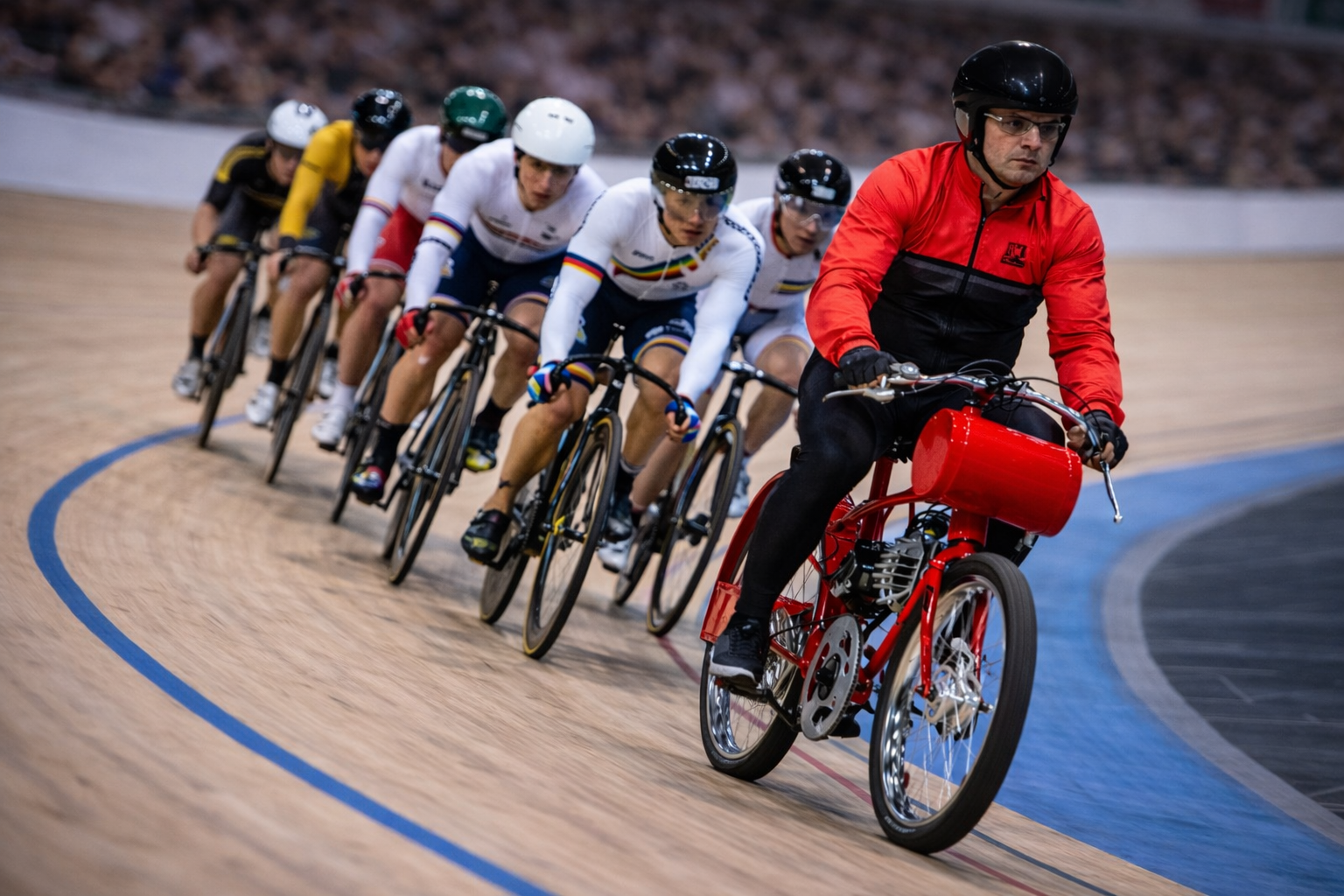
Most people meeting Japanese keirin for the first time notice the speed. After that, they notice the order. Riders do not simply fan out and wait for instinct to take over. They gather into single file. They move with a kind of shared tension that can look strange to an audience raised on Olympic keirin: too organised to be chaos, too fraught to be simple teamwork. That is often the moment the domestic sport begins to feel different.
The mistake is to treat that formation as a visual quirk, something that belongs to the opening laps before the race becomes serious. In Japanese keirin, the seriousness begins there.
It does several things at once. It gives the race shape. It makes overtaking harder. It distributes responsibility. It lets riders declare intent without saying a word. And because these formations are often built by riders who know each other well, often from nearby registration areas, they carry familiarity, trust and habit into the race itself. What looks from the outside like arrangement is, from the inside, a language.
Japanese keirin is not built to be read only in the final straight. The domestic race asks its audience to understand what is forming long before the finish. The warm-up matters because riders are already showing themselves and shaping the contest. The start matters because they are not simply accelerating; they are trying to gain the position that best suits their strengths, while weighing the wind, the banking and the likely behaviour of those around them. What appears to delay the race is actually its first expression.
This is not just a queue of riders. It is a tactical unit. It protects the front rider, makes overtaking more difficult, and tells the audience where support, patience and pressure are likely to come from next.
It gives riders roles
This is where Japanese keirin begins to move away from the version of the event most of the world knows. In the Olympic format, casual viewers can still watch the race as a gathering of individuals waiting for the right moment to attack. In the domestic Japanese sport, the race makes less sense if you do that.
The front rider matters, of course, but is not the whole story. The second rider matters too, often far more than outside audiences realise. That rider may be shielding the leader from behind, guarding position, widening the gap, blocking a move or waiting for the moment when loyalty gives way to opportunity. The contest is not only about who is strongest. It is also about who is doing what for whom, and for how long.
Part of what gives Japanese keirin its peculiar tension is that the structure is cooperative, but only up to a point. The structure is cooperative, but only up to a point. It is a temporary order inside a sport of individual ambition. Riders work together because it improves their chances, because it makes the race more navigable, because a strong formation is harder to pass than a lone rider. But everyone knows the final moments will come down to individuals. The race is full of shared interest, right up until the instant it is not.
The second rider is often the key
The rider sitting second is not merely following. They are often doing the invisible work that allows the whole structure to remain meaningful. They protect the rear of the leader. They support the battle for position against other groups. They block riders trying to move up. They can widen the gap and force others to cover more distance if they want to come across. When one group overtakes another, they may be the rider who chases and forces a new shape onto the race. Even the messiest moments usually have order underneath them.
This is one reason Japanese keirin can look more violent and more controlled at the same time. The violence comes from riders contesting narrow tactical spaces with enormous urgency. The control comes from the fact that those spaces are already defined.
Protecting the rear of the leader
Blocking riders trying to move up
Widening the gap to the front rider
Chasing when race shape changes
Holding order until the race becomes individual
The race changes in phases, but the structure holds it together
The same logic runs right through the race
The opening matters because riders are trying to reach the position that best suits them. The middle matters because the pacer gives shape to the contest while the field settles into something more legible. The bell or gong matters because it signals a change in temperature: one-and-a-half laps from the finish, the pace rises, the space tightens and what has been building starts to declare itself. By the final straight, the riders are packed, and the order is either about to deliver someone into the finish or come apart under pressure.
Japanese keirin often feels denser than Olympic keirin because the domestic race is being read through a sequence of tactical transitions. The audience is not merely waiting for a sprint. It is watching a structure tighten.
The race card teaches the audience how to read what is coming
Another difference sits off the track. Japanese keirin assumes an audience that wants more than names and numbers.
The race card does not just identify the riders. It gives registration location, rank, previous rank, age, school term, rider characteristic, race score, winning techniques, backstretch leads, homestretch leads, rapid starts, win ratios and recent results. In other words, it gives the reader a way of understanding how a rider usually behaves before the race even begins. It is not just telling you who is in the field. It is telling you how the contest is likely to take shape.
Riders are not blank figures waiting to produce surprise. They arrive carrying tendency and type. A rider with strong backstretch numbers is telling you something. A rider who repeatedly starts aggressively is telling you something else. A rider whose winning techniques point one way may shape the race differently from a rider whose victories tend to come another way. The domestic sport teaches its audience to read pattern before it asks them to judge outcome.
In Japanese keirin, the audience is given clues before the flag falls. Rider characteristic, race score, winning techniques, B, H and S indicators, and recent results all help explain what sort of shape may emerge and what sort of race may suit each rider.
This is where Japanese keirin becomes itself
This matters because it is the point where Japanese keirin stops being mistaken for a sprint with a paced opening and becomes what it actually is: a race of roles, pressure, trust, timing and tactical reading.
This structure makes the sport legible. It also makes it subtle. It explains why a race can feel tactical even before anyone attacks properly. It explains why the second rider can matter almost as much as the leader. It explains why the warm-up matters, why the start matters, why the bell matters, and why the finish feels like the breaking point of something that has been organised for much longer than a casual viewer may realise.
That may be the clearest way of explaining why Japanese keirin still feels different from the Olympic version. The Olympic race gives the world a dramatic event. Japanese keirin asks the audience to read a tactical language.
And that language begins here.