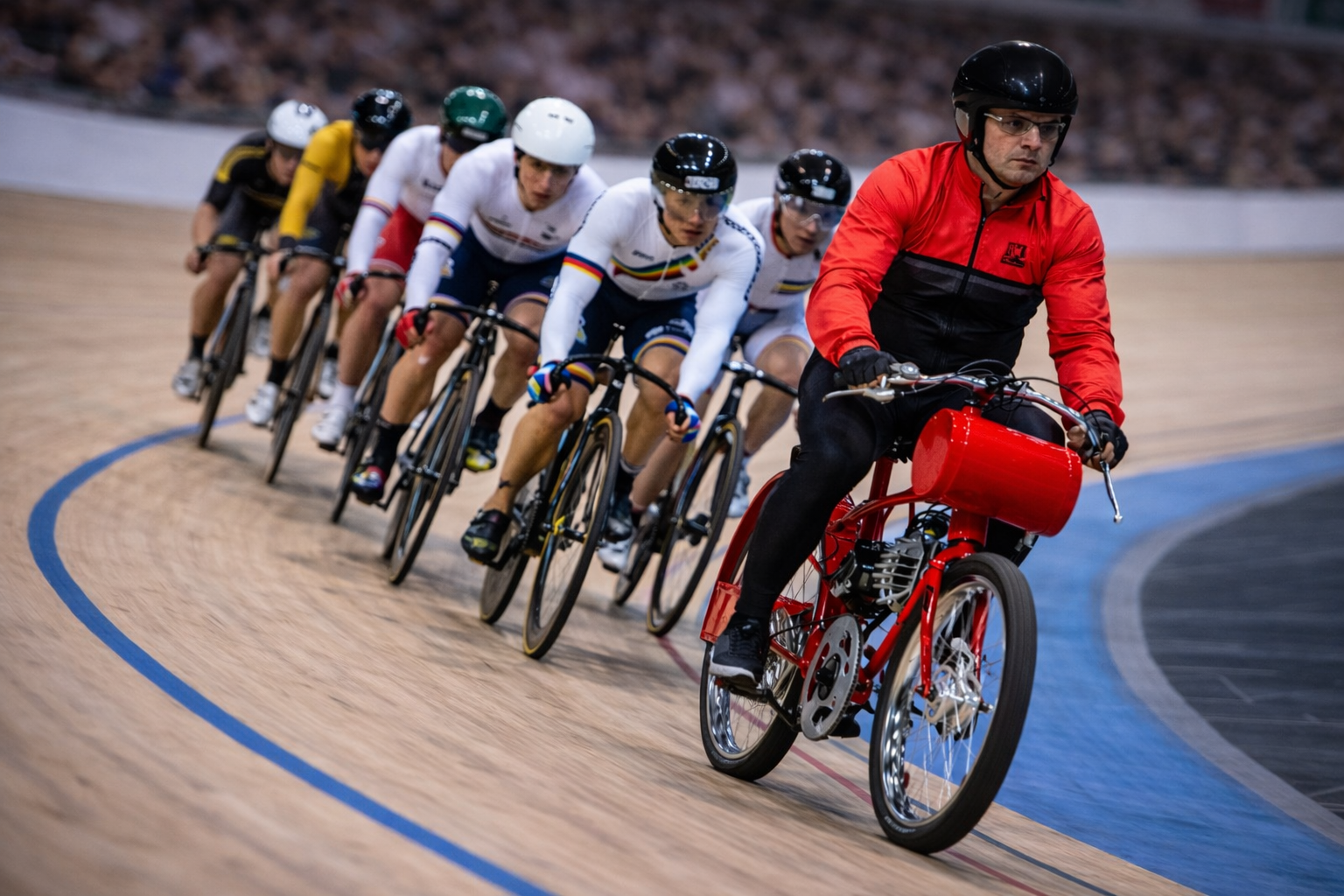
Keirin in Japan is not just a race format, nor only a domestic sporting tradition, nor merely a betting product that happens to involve bicycles. It has been built, over decades, as a public institution: a sport with rules, ranks, grades, schools, audiences and revenues, but also a sport expected to justify itself in wider civic terms. That is a very different proposition from the one most of track cycling lives with elsewhere.
International track cycling has spent years looking for stability. It has searched for stronger calendars, clearer identities, bigger audiences and more durable commercial logic. Japan solved that problem in another way. It did not build keirin as an occasional championship spectacle and then hope the rest would follow. It built a complete domestic world around it.
The dates tell part of the story. In 1948, Japan was still a defeated country under occupation, trying to rebuild its institutions, economy and international reputation. Keirin emerged in that setting not simply as a new sporting spectacle, but as part of a wider attempt to create structured public value from entertainment - a domestic system that could generate revenue and direct it back into social welfare, education, sport, medicine and disaster relief. That did not erase the weight of recent history. It did, however, place keirin inside a very different national project: reconstruction, order and civic usefulness.
The races came with a structure. The structure came with a purpose. The purpose was not only to stage competition, but to create a revenue stream that could be directed back into public life.
Supporting local buses and travelling medical check-up vans, Braille printers and publications, schools for the blind, major sports events and hands-on science education programmes. The official framing is clear: keirin is expected to do something beyond entertaining punters and crowning winners.
Most sports ask to be valued for what happens inside competition. Keirin in Japan has also been built to justify itself outside competition. That is one reason it has retained a civic and cultural weight that goes beyond race day.
A sport that was never only a sport
The Japanese model looks unusual to outsiders for a reason. In much of the world, cycling tends to defend itself in sporting language: medals, participation, health, entertainment, prestige, broadcast value. Keirin can make all of those claims too. But the domestic model has always had another layer. It has existed inside a public-benefit logic that helps explain why the sport feels more settled, more legible and more rooted than many international cycling properties do.
The effect is not only financial. It is cultural.
A sport treated as a public institution tends to carry itself differently. It has more reason to preserve continuity. It has more reason to maintain rules, ranks, event grades and race-reading habits that might otherwise be stripped away in the name of speed, simplicity or television friendliness. It does not need to reinvent itself every few years in order to prove that it matters. It already sits inside a broader argument for why it should exist.
It has the races, certainly, but it also has the ladder of grades, the rank structure, the school, the line-based tactical language, the race card, the off-track betting network and the expectation that audiences will learn how to read more than just the finish. These are not random quirks preserved out of nostalgia. They are the habits of a sport that has had an institutional home for a long time.
Why this matters more than it sounds
This is not just governance, the public-institution model changes what keirin feels like. It helps explain why the sport can sustain a domestic hierarchy from FII up to the KEIRIN Grand Prix, why riders are sorted through a rank structure, why there is a school severe enough to shape behaviour as much as athletic ability, and why the audience is expected to approach the race as something to be studied as well as watched. These are not detached features. They belong to the same logic.
The contrast with much of international track cycling is stark. Outside Japan, track cycling often feels as though it is still negotiating with itself about what it wants to be. Is it an Olympic sport first? A television product? A development pathway? A heritage discipline? A venue business? A national-medal factory? The answers shift depending on who is speaking and what problem they are trying to solve.
Japanese keirin looks more coherent because its answer has been steadier. It is a sport, yes. It is also an institution.
The system is not simple. It has a centre of gravity.
A year-round domestic calendar
A formal event ladder culminating in the KEIRIN Grand Prix
A rank structure that sorts riders by level
Keirin school as a route into the sport
A wide off-track betting network
A public rationale beyond race-day entertainment
The audience is part of the institution too
Keirin in Japan is not simply sold as a flash of speed. The audience is taught to understand lines, phases, rider types, marks on the race card, grades, ranks and tactical tendencies. The sport expects literacy from its public. That expectation only really makes sense inside a system that sees itself as durable. A race can ask to be watched. An institution can ask to be learned.
Keirin may have held its shape partly for this reason. It is not only that the sport has a public-benefit function. It is that the function has helped justify a whole culture around the racing: the betting sites, the velodromes, the tactical language, the way the domestic audience reads form and intention. The ecosystem does not begin and end with the riders.
What the rest of track cycling might learn
None of this means the rest of the world can simply copy Japan. Keirin sits inside a very specific national history and public culture. Its relationship with betting, local infrastructure and public benefit is its own.
But it does raise an uncomfortable question for international track cycling. What happens to a sport when it is asked to survive only as a spectacle? What happens when it has no stable institutional logic underneath it? Too often, the answer is what we have already seen elsewhere: unstable calendars, uncertain identities, stop-start commercial thinking and an endless appetite for reinvention.
Keirin suggests another possibility. A sport can remain tactically rich, culturally distinctive and commercially legible if it is allowed to exist inside a larger civic framework. It can keep its language. It can keep its rhythms. It can keep its sense of itself.
Perhaps that is the most important lesson Japan’s keirin system still offers the rest of cycling. The lesson is not just about race craft or line formations or tradition. It is about what becomes possible when a sport is treated as something worth building around, not merely something worth scheduling.
Japanese keirin does not feel substantial only because it is old. It feels substantial because it has been built as a complete domestic institution: one that can justify its existence in public terms, sustain its own structures and expect its audience to meet the sport on its own terms.
The six internationals in Japan this summer are entering that world at an interesting moment. They are arriving through a defined summer route, but the larger point lies beyond them. What makes Japanese keirin unusual is not simply that overseas stars can race there. It is that they are entering a sporting system that still knows what it is. The UCI’s 2026 programme authorises nine F1 rounds and one GIII meeting at Wakayama, placing the internationals within a bounded part of the domestic structure rather than the whole of it.
That is rarer in modern track cycling than it ought to be. It is one of the main reasons keirin in Japan still carries a weight that the rest of the sport, too often, is still trying to recover.