One of the easiest mistakes outside Japan is to treat the women's story as a smaller version of the men's one. It is not.
Ellesse Andrews, Hetty van de Wouw and Mathilde Gros are part of the six-rider international group authorised for Japan's 2026 summer programme, which runs across nine Keirin World Series events from early June to early September, plus the World Cyclist Fund Keirin at Wakayama in August. Once they arrive, though, they are not simply entering a female wing of the men's domestic sport. They are entering Girls' Keirin, a category with its own identity and its own place in modern Japanese racing.
Girls' Keirin is not just "women's keirin" in the loosest sense. It is a newer part of the Japanese system, introduced in July 2012, and it has grown into something visible and popular within the wider keirin world. That gives this summer's women's story a different kind of shape. Andrews, Van de Wouw and Gros are not merely stepping into an old institution built entirely by and for men. They are entering a competitive space that sits inside Japanese keirin without simply mirroring the men's side of it.
The women are not just joining "Japanese keirin" in the abstract. They are entering Girls' Keirin: a domestic category introduced in 2012, active within the wider Japanese system, and built with its own competitive identity.
A newer world inside an older one
The men entering Japan this summer are walking into one of the oldest, most codified and most socially embedded forms of cycle sport in the world. The women are doing something slightly different. They are entering a category that is newer, more visibly shaped by modern international rules, and more clearly tied to the question of how Japanese keirin wanted women to race and be seen.
That difference is unusually direct in the official English-language material. Girls' Keirin is presented there as operating under different rules from the men's version, with more international rules incorporated so that women could be competitive on the world stage. The women's side was not simply created as a copy of the men's domestic model. It was built with a different purpose in mind.
Andrews, Van de Wouw and Gros are not just elite riders entering a famous Japanese institution. They are entering a domestic form that sits closer, in some ways, to the international sprint world they already know, while still belonging unmistakably to Japan's own racing culture. The interest lies in that tension. This is not a story about three women stepping into something wholly alien. It is a story about three women stepping into a system that has already been adjusted, at least in part, around the demands of modern female competition.
The rules are different because the racing is different
The first place that difference becomes visible is the bicycle.
Girls' Keirin uses colourful carbon frames and carbon five spoke/disc wheels, unlike the steel machines used in the men's domestic discipline. It is more than a cosmetic distinction. It tells you that the women's side was not designed simply to inherit the men's equipment culture unchanged. Even before the race begins, the visual language is different.
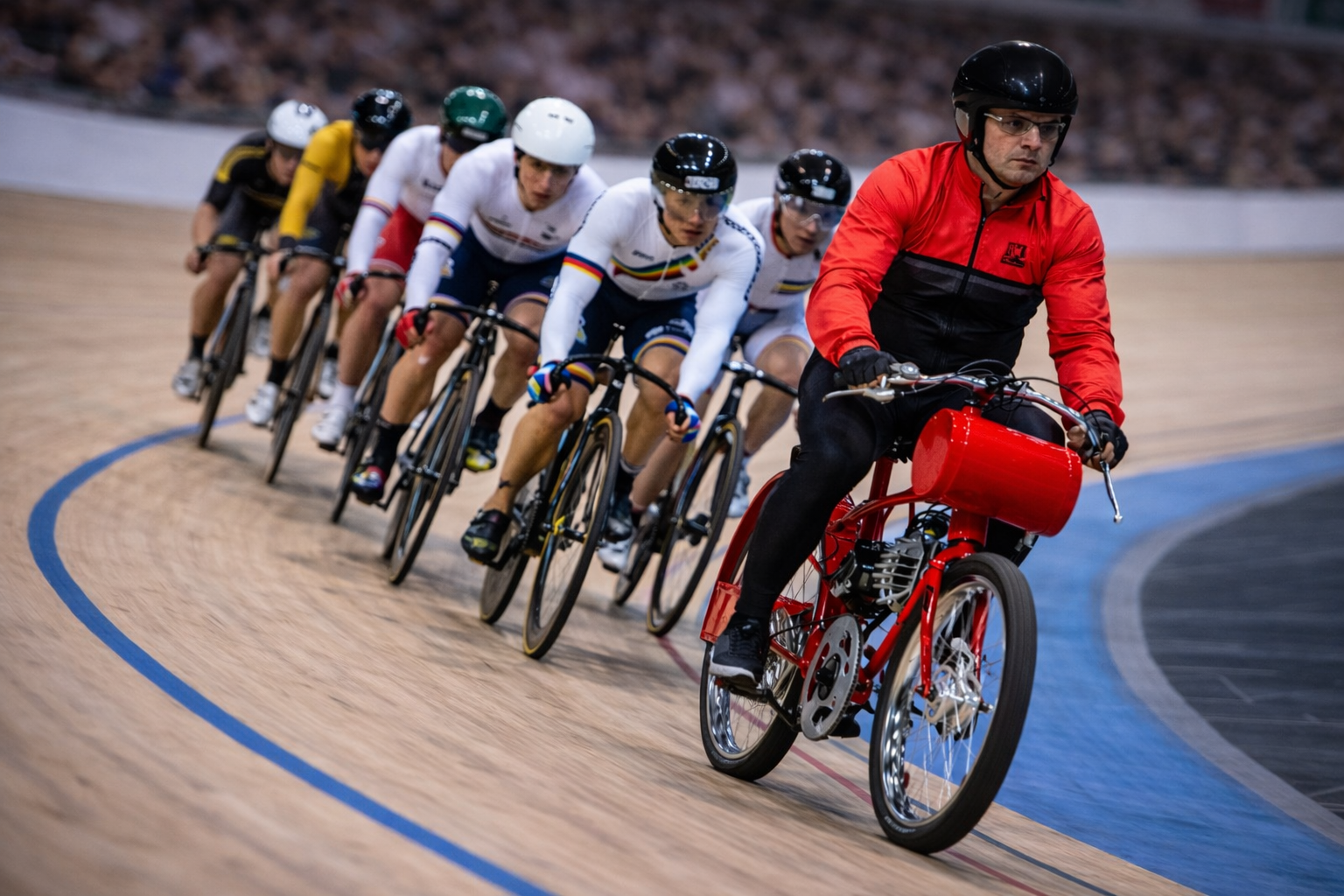
The next difference is in the start. In the men's domestic version, the pacer leads the riders from the front. In Girls' Keirin, the pacer starts from half a lap behind and the race begins when the field crosses the starting line. It looks like a small technical point, but it changes the feel of the event from its first moments. In feel, it is not. The event unfolds differently from its first moments.
And then there is the biggest difference of all: the line.
On the men's side, line formations are fundamental to understanding the race. On the women's side, it is an individual battle rather than a line-based contest in the same sense. From start to finish, it is meant to be clearer who is winning and who is losing, making the event easier to follow. It goes to the centre of how the women entering Japan this summer will need to read the racing around them.
Carbon frames rather than the men's chrome-moly steel frames
Colourful bicycles and differentiated rear wheels
A different pacer start position
Less emphasis on line formations as the organising logic of the race
A more directly individual battle from start to finish
Why this matters for Andrews, Van de Wouw and Gros
Andrews arrives as one of the most explosive female sprinters in the world. Van de Wouw arrives with elite international speed and big-race composure. Gros brings top-level pedigree and a racing profile that has often mixed force with fluency. All three are good enough to make the trip matter on talent alone. The more revealing question is not simply how fast they are. It is what kind of keirin Japan is asking them to ride.
Girls' Keirin sits in an interesting middle ground. It is unmistakably Japanese, with all the cultural weight that implies. But it is also framed as a form shaped to keep women competitive on the world stage. That may make it less foreign to these riders than the men's domestic format can seem to outsiders. At the same time, it does not make it ordinary. They are still entering a domestic sporting world with its own audience, expectations and habits. The category may be newer and more internationally aligned in some respects, but it is still part of a distinctly Japanese system.
It deserves its own feature rather than a paragraph in the men’s story. The question is not just whether Andrews, Van de Wouw and Gros can win races in Japan. It is whether their strengths, developed at the top of modern international sprinting, map cleanly onto a category that sits between two logics at once: Japanese keirin culture on one side, international women's competition on the other.
Not simply adaptation to a new country, and not simply a test of speed. The real question is whether elite female sprinters shaped by the modern international track system can thrive inside a domestic category that is Japanese in culture, but deliberately more international in some of its competitive design.
Not an afterthought, but a different doorway into Japan
When people outside Japan talk about "Japanese keirin", they usually imagine the men's domestic world first: steel bikes, lines, rank, codified tactics, the old hardness of the sport. Girls' Keirin complicates that picture in a useful way. It shows that Japan's keirin culture is not static. It has already made room for a women's category that is newer, more visibly modern in equipment and rule design, and presented as active and popular within the wider sport.
Andrews, Van de Wouw and Gros are more than passengers in the 2026 story. They are not simply accompanying the men's narrative. In some ways, they are entering a part of Japanese keirin that may tell us as much about where the sport is going as about where it has come from. The men illuminate the depth of the old domestic order. The women illuminate how that order has already been reworked.
The simplest way to put it is this: the women going to Japan this summer are not stepping into the same keirin the world usually imagines when it thinks of Japan. They are stepping into a newer, sharper and more deliberately shaped category within it.
That is exactly why the story deserves to stand on its own.