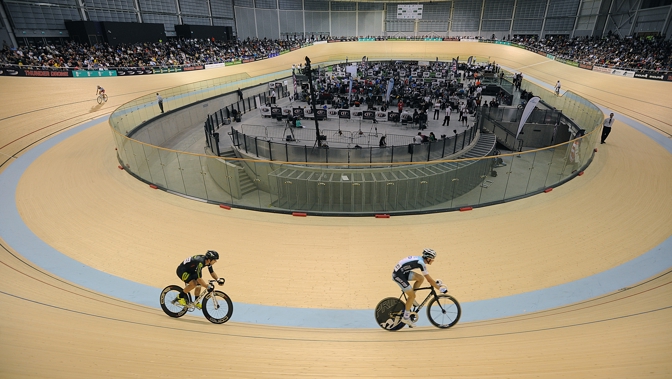
The Sir Chris Hoy Velodrome occupies a very particular place in modern track cycling. It is not old enough to lean on deep historical romance in the way some classic European tracks can. But it has something else instead: immediacy. Glasgow feels loud, close and intense. It feels like a track that asks riders to perform in public rather than simply race in front of people.
That is part of what has made it important so quickly. Built in 2012 inside the Emirates Arena, the velodrome arrived as a major modern Scottish venue and then immediately had to prove itself. The 2014 Commonwealth Games gave it one type of credibility. The 2023 UCI Cycling World Championships gave it another.
That combination matters. One event can make a building famous. Repeated high-level use makes it part of the sport.
For another British indoor track with a different identity, see our feature on Manchester Velodrome. Where Manchester often feels like the home of a system, Glasgow feels more like the home of an atmosphere.
Glasgow Velodrome quick facts
- Official venue name: Sir Chris Hoy Velodrome
- Location: Emirates Arena, Dalmarnock, Glasgow
- Opened: 2012
- Track length: 250 metres
- Track surface: Siberian or Serbian pine, depending on venue wording
- Named after: Sir Chris Hoy
- Major events: 2014 Commonwealth Games, 2018 European Championships, 2023 UCI Cycling World Championships
- Official venue page: Sir Chris Hoy Velodrome
Glasgow Velodrome timeline
- 2012 - The Sir Chris Hoy Velodrome opens inside the Emirates Arena.
- 2014 - It hosts track cycling at the Glasgow Commonwealth Games.
- 2018 - Major championship racing returns for the European Championships.
- 2023 - The UCI Cycling World Championships bring the world's best to Glasgow.
- 2026 - The venue remains central to Glasgow's wider sporting identity and returns to Commonwealth Games use.
Why Glasgow mattered
A national or regional velodrome does more than provide a racing surface. It gives a sport somewhere to gather, somewhere to sound like itself and somewhere to be seen properly. Glasgow gave Scotland that kind of place.
This mattered especially because the track was not tucked away from public view or treated as an obscure specialist asset. It sat inside a broader arena complex, in a city with real event experience and an appetite for making major sport feel like an occasion. That gave the velodrome a slightly different tone from some purely training-led venues.
Glasgow was built to be used, but it was also built to be heard.
The track itself: 250 metres and built for modern championship racing
On paper, the Sir Chris Hoy Velodrome is clear enough: a 250-metre track made from fast timber and designed for elite competition. But tracks are never only numbers. Riders remember what the building does to the air, to the sound and to the space between themselves and the crowd.
That is where Glasgow becomes distinctive. The venue's reputation is not just technical. It is emotional. A championship session there can feel packed in, intense and immediate. The racing never seems far away from the spectators, and the spectators never seem far away from the riders.
That is why the venue often feels bigger in memory than its age might suggest.
The track that gave Scotland a proper international stage
For Scotland, the velodrome's importance is straightforward. It gave the country a true indoor track venue capable of staging the sport at the highest level. That changed what could be hosted, what could be imagined and what could be normal.
Once a building like this exists, a sporting culture becomes easier to sustain. Riders can train in it, fans can attach to it, organisers can plan around it, and major events can stop feeling like something that only happens elsewhere.
That is how a venue becomes meaningful very quickly. It becomes the place where the sport no longer has to explain why it belongs.
The events that gave Glasgow its weight
2014 Commonwealth Games
The Commonwealth Games gave Glasgow its first major layer of track-cycling memory. That is where the building introduced itself most clearly to a broader audience and began to attach itself to the sporting life of the city.
It also mattered because home multi-sport events can fix a venue in national memory far faster than specialist championships alone.
2023 UCI Cycling World Championships
If the Commonwealth Games gave the track visibility, the 2023 UCI Cycling World Championships gave it elite global status. The world's best riders came to Glasgow and the velodrome had to carry the full pressure of track and para-track world championship racing.
It did more than that. It helped set the tone for the whole championships. That matters. A venue becomes important when it stops merely receiving an event and starts shaping how the event feels.
The riders who gave Glasgow its voice
The building's name alone tells part of the story. Sir Chris Hoy gave the venue an instant local and national reference point. But the track's emotional life comes from more than the man whose name is on the wall.
It comes from championship nights, Scottish crowds, British medal moments, visiting champions, para-cycling finals and the thousands of riders who have used the boards outside the very biggest events. Those layers are what turn a venue from a project into a place.
That is why Glasgow feels lived in as well as staged.
Can the public ride the Glasgow velodrome?
Yes. That remains one of the venue's strengths. Official Glasgow Life material describes the velodrome as a place for large competitions, community programmes and broader use rather than a closed elite-only site.
That matters because it keeps the building connected to the sport below headline level. The venue remains something riders can encounter directly, not only on television.
For current information, the best place to start is the official Sir Chris Hoy Velodrome page.
Why Glasgow still matters
The Sir Chris Hoy Velodrome matters because it has become one of the clearest examples of a modern indoor track earning stature quickly and honestly. It is not trying to borrow someone else's history. It has built its own reputation through atmosphere, event quality and continued public life.
In that sense, Glasgow feels like a distinctly modern classic. Not ancient. Not mythical. Just real, loud and repeatedly trusted.
Glasgow Velodrome FAQ
Where is the Glasgow velodrome?
The Sir Chris Hoy Velodrome is in the Emirates Arena complex in Dalmarnock, Glasgow.
How long is the Glasgow velodrome track?
The track is 250 metres long.
Why is the Glasgow velodrome important?
Because it became one of Scotland's defining modern track venues through the 2014 Commonwealth Games, the 2023 UCI Cycling World Championships and its public use.
What major events has the Glasgow velodrome hosted?
Its best-known events include the 2014 Commonwealth Games, the 2018 European Championships and the 2023 UCI Cycling World Championships.
Can the public ride the Glasgow velodrome?
Yes. The venue is used for community programmes and wider public access as well as major events.