This is not a criticism. It is understandable as Track frame sizing is confusing.
Manufacturers use different conventions. Some still rely heavily on traditional height charts. Others have shifted towards geometry-driven sizing. Riders see elite positions online and understandably try to replicate them.
But modern track bikes do not reward guesswork and when the base frame is wrong, everything built on top of it becomes a compromise.
Why This Is Happening?
Traditional track sizing was relatively simple.
You chose a frame based largely on height. A 54cm was a 54cm. Head tubes were moderate. Cockpits were conventional. A stem swap could fine-tune things.
That logic still appears in many manufacturer size charts, particularly among lower-cost brands that dominate the amateur scene but do not have deep professional integration.
Height equals frame size - it is a helpful starting point, but it is not the final answer.
Modern track racing demands something different. Your goal is not to match a road fit sheet. Your goal is to choose a frame that allows you to achieve:
- An efficient legal position under UCI rules
- Stable handling at race speed
- Clean weight transfer in standing efforts
- A cockpit you can hold under load
Height alone cannot deliver that.
Remember: Start with height, decide with geometry.
The 100mm Rule: Constraint, Not Target
One of the most common misunderstandings in amateur track racing revolves around the UCI 100mm rule.
UCI Article 1.3.022 states that the front of the handlebars must not exceed a vertical plane 100mm in front of the front wheel axle.
This is often interpreted as a fitting goal:
"I'll set my bars to 100mm and I'll be fast."
But the rule is a limit, not a prescription.
If your frame has:
- A tall head tube (high stack)
- Short effective reach
- A short front centre
Then reaching that 100mm limit may require:
- Very long stems with extreme angles
- Aggressive bar rotation
- Compromised steering behaviour
The rider achieves legality, but loses stability.
Remember: If the only way to comply with the rule is extreme hardware, the frame choice is probably wrong.
Further reading on modern track sizing can be found here: Modern Track Bike Sizing Guide
Front Centre: The Number That Explains Handling
Most riders talk about reach or top tube length.
On a modern track bike, front centre often tells you more.
Front centre (bottom bracket to front axle) influences:
- High-speed stability
- Steering calmness in the banking
- Front-wheel load during standing starts
- Overall weight distribution
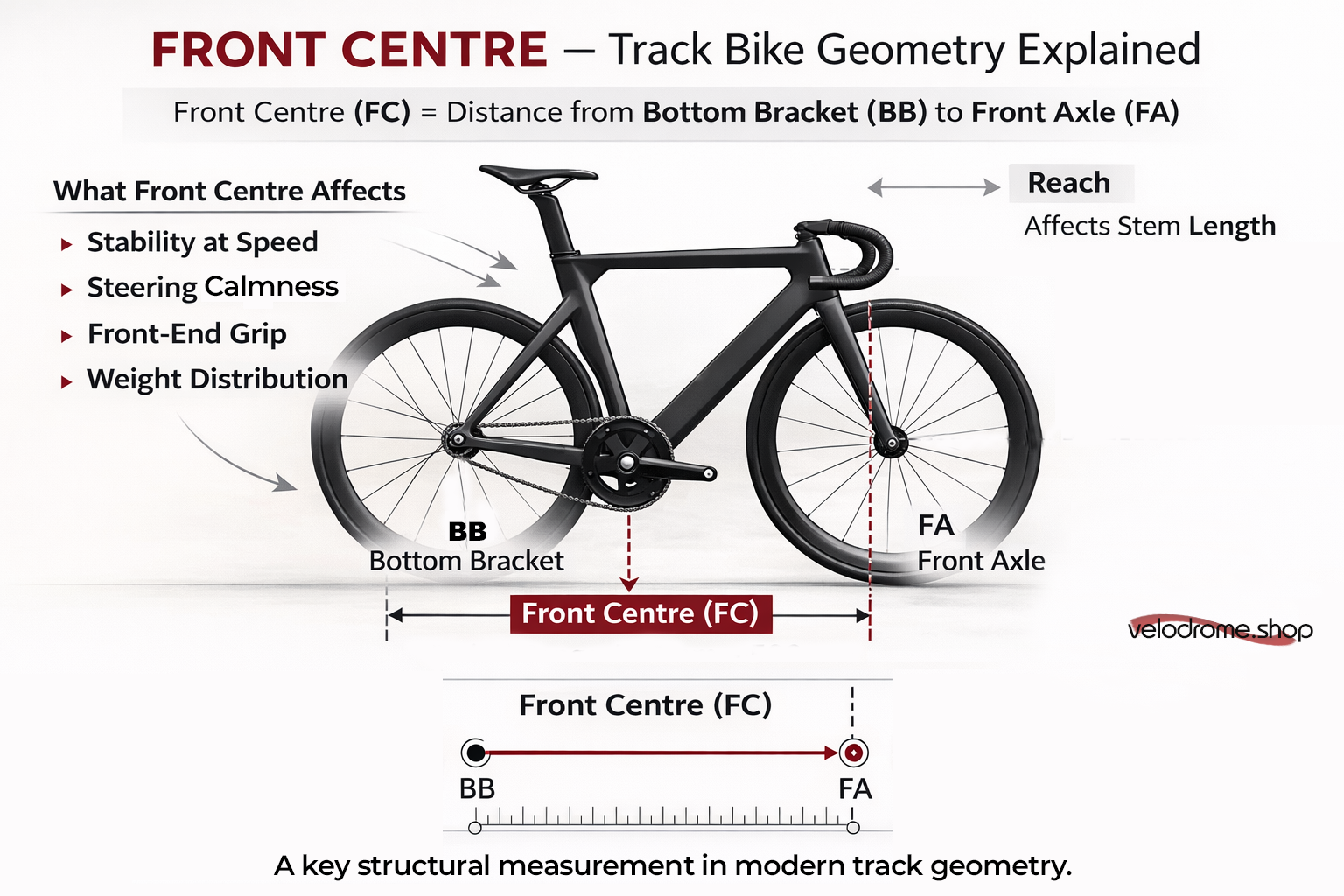
Front Centre Explained
Front centre influences stability at speed. Reach mainly influences stem length. If you can only correct handling with extreme stem choices, the frame is likely the issue.That distinction matters.
You can correct reach with a stem, you cannot correct front centre with anything.
When riders choose a frame purely from a traditional height chart and ignore front centre, they are often surprised when the bike feels nervous at speed — or, more commonly, they simply adapt to instability without realising the bike is working against them.
The Tall Head Tube Pattern
One recurring pattern in domestic racing is the tall head tube frame being pressed into service as something it was never quite designed to be. Riders understandably want a lower, more aggressive position, and so the front end is adjusted to chase it. The result is often a very long stem, sometimes at a sharp negative angle, with the bars pushed forward to the limit of what the rules allow. On paper, it achieves the numbers. On the track, it can feel unsettled.
When that happens, small signs start to appear. Shoulders creep upwards. Elbows lock rather than float. The front wheel drifts slightly under load. The bike requires constant micro-corrections through the banking. None of it looks dramatic, but together it creates a sense that the rider is holding the bike in position rather than being supported by it.
Now compare that to elite track bikes.
Yes, professional riders often use long stems, and many sit long and low. But if you look carefully at a true side-on image, their setups tend to appear proportionate. The head tube suits the position. The stack allows the drop without forcing it. The stem may be long, but it looks intentional rather than compensatory. The rider appears settled into the bike, not braced against it.
That difference is subtle, but it matters. Elite riders are not rescuing geometry; they are working within it.
The Side-On Photo Test
There is one simple exercise that reveals everything.
Get a true, perpendicular side-on photo of yourself at speed.
Not head-on or a flattering angle for your next Instagram selfie
A proper side profile.
Now compare it to a side-on photo of a professional rider in your event.
What do you see?
Patterns that are surprisingly common at domestic level:
- Excessively high shoulders
- Elbows locked
- Torso collapsed
- Bars either too far away or too close
- A visible "stretch and brace" posture
Most riders discover these patterns not through criticism but through experience: one session where something ‘feels a bit off’, and suddenly the side-on frame of reference becomes incredibly valuable.
Common professional patterns:- Low but relaxed shoulders
- Neutral arm angle
- Smooth line from hip to shoulder
- No visible tension through the front end
This is not about copying someone else's position.
It is about asking:
Does my setup look coherent, or does it look like a workaround?
If I put my side-on photo next to a professional rider in my discipline, does the overall picture look structurally similar — or fundamentally different?
Often the answer traces back to frame size.
Custom Paint Before Geometry
Another quiet factor is aesthetics.
Amateurs understandably want:
- Custom colours
- Distinctive finishes
- Something that looks special
There is nothing wrong with that but frame geometry should be chosen before paint.
Remember: You race geometry, you photograph paint.
Choose the correct base frame first. Everything else is secondary.
The Gold Standard Process for Modern Track Sizing
A calm, structured approach removes most of these problems.
1. Start with the brand height guide as a reference only.
Shortlist one or two sizes only.
2. Decide your event focus.
Sprint: favour agility and controlled weight transfer.
Pursuit / kilo: favour high-speed stability.
Bunch: aim for neutral, predictable handling.
3. Compare front centre between shortlisted sizes.
This is often the clearest indicator of how the bike will feel at speed.
4. Use stack to confirm practicality.
Can you achieve your bar height without extreme stems or spacer towers?
5. Treat reach as a cockpit number.
Adjust stem length sensibly. Avoid extremes.
6. Apply the 100mm rule last.
Ensure compliance without destabilising the bike.
Remember: Frame first, Cockpit second.
Rule compliance within sensible limits.
Rough Front Centre Geometry ranges by Rider Height
Velodrome.Shop have a useful guide to choosing a frame size based on Front Centre in comparison to your height
These figures are general reference ranges for modern track frames. They are not rules, and brand geometry varies significantly. Front centre gives the clearest indication of how long and stable a track bike will feel. Reach mainly affects stem length and should not be used on its own to judge frame size.
Further reading on modern track sizing can be found here: Modern Track Bike Sizing Guide
The Steerer Chimney: A Safety Issue That Should Disappear
One front-end detail deserves specific attention.
Exposed fork steerers protruding above the stem. Often called a "steerer chimney".

This happens when the steerer tube extends beyond the top of the stem, leaving a rigid column exposed.
In a crash, that exposed tube can become a serious impact point. In cycling history, riders have suffered severe internal injuries after striking protruding components in this area.
On a velodrome, in close racing, the risk is not theoretical.
It is avoidable.
If your steerer protrudes significantly above your stem: have it cut without delay
Most local bike shops can cut a steerer quickly and safely for a modest labour charge — often well under £20. On a track bike, with no integrated brake hoses or cables to disturb, it is a straightforward job.
This is not about aesthetics. It is about safety. It is easily corrected, a detail that, if simply noted more often at events and checks, could reduce avoidable risk across the field. When the solution is this straightforward, it makes sense for riders — and the sport more broadly — to address it proactively
This Is an Opportunity, Not a Critique
Amateur track riders are not lacking commitment. Far from it. They train consistently, race courageously, and invest seriously in their equipment.
What often happens is not carelessness, but confusion.
Traditional height-based sizing still circulates. Modern cockpit limits sit alongside it. Elite positions are visible everywhere online. Stems, spacers and angles promise easy adjustment. It is easy to blend all of that together without a single framework guiding the decisions.
And when those systems collide, the bike can start working against the rider rather than with them.
When the underlying geometry is coherent, everything changes. The bike tracks calmly through the banking. Sprint efforts feel supported rather than braced. Confidence in traffic improves. Small corrections disappear. The rider stops thinking about the front end and starts thinking about racing.
That shift is not marginal, it is structural.
A correctly sized frame.
A stable, predictable front end.
A cockpit that is clean, safe and proportionate.
A position that holds up under race load, not just in the workshop.
From there, everything else — chains, tyres, aerodynamics, marginal gains — begins to matter in the right order.
Handling is performance.
Safety is performance.
Geometry is performance.
Everything else builds on that — and when the foundation is right, the rest of the sport becomes simpler and riders can focus on racing rather than compensating.


